
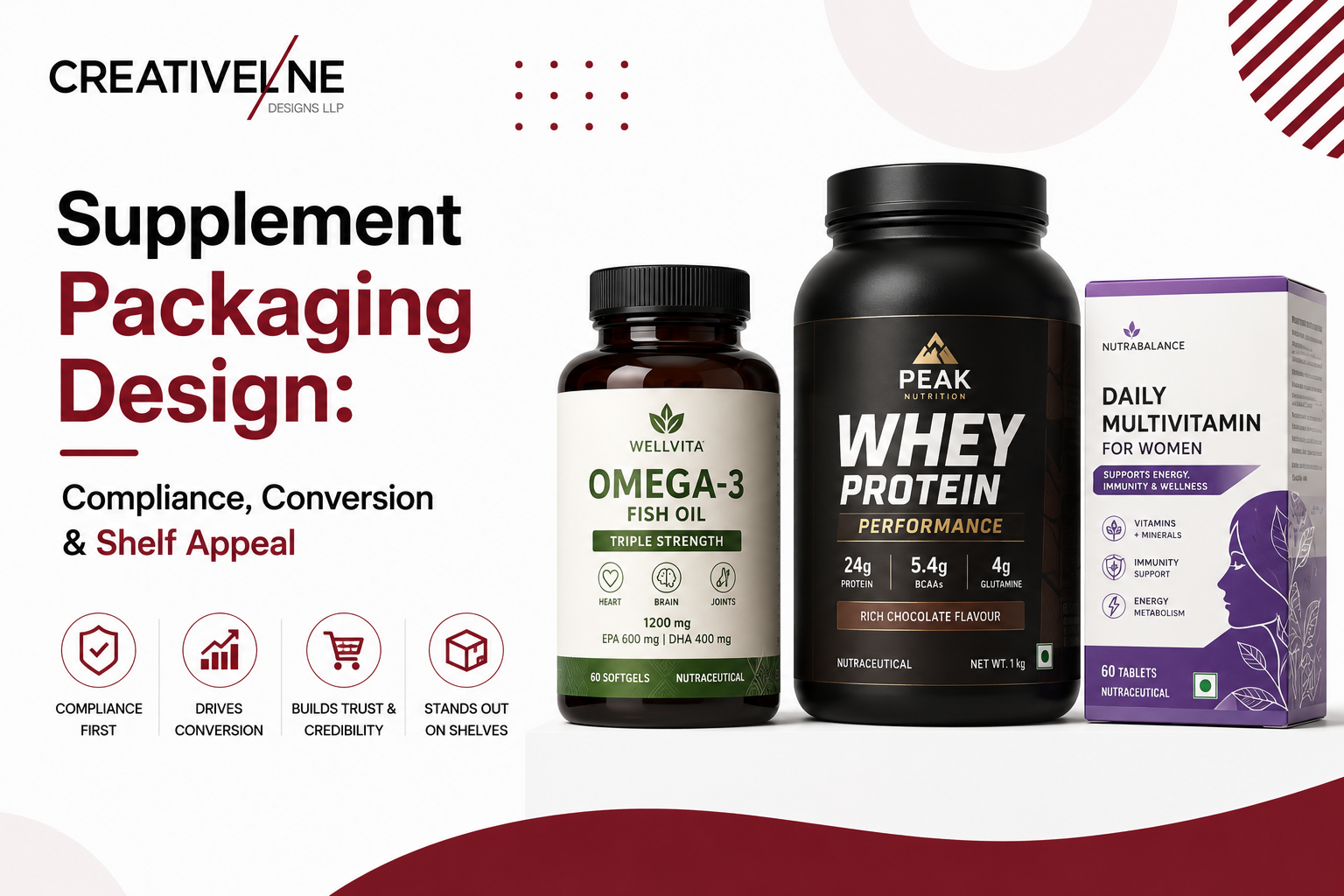
Supplement packaging design is the visual and structural design of containers and labels for nutraceutical, dietary, sports nutrition, and health supplement products. It is one of the trickiest packaging categories in India because it has to do three jobs at once — earn trust in a category full of skepticism, comply with FSSAI and AYUSH labelling rules, and look good enough on shelf and on Amazon to convert at scale. Brands that get this right capture buyers who shop with both their head and their gut. If you are launching a supplement, protein, vitamin, or ayurvedic health product, working with a packaging design company that has handled compliance-heavy categories will save you weeks of regulatory rework.
This guide covers the design principles, container choices, regulatory rules, cost ranges, and conversion levers that decide whether a supplement brand grows past its first ten thousand bottles.
Why Supplement Packaging Is Harder Than Most Categories
Three things make this category uniquely demanding.
1. Trust Is the Single Biggest Buying Driver
Buyers cannot test a supplement at the shelf. They have to believe it works before they pay for it. Every visual cue — typography, colour, certifications, manufacturer details, ingredient transparency — feeds into that belief. A pack that looks generic or sloppy kills conversion no matter how good the formulation is.
2. Compliance Is Mandatory and Non-Negotiable
FSSAI, AYUSH, and Legal Metrology rules dictate exactly what has to appear on the pack, in what minimum sizes, and in what languages. Get any of this wrong and the product cannot legally be sold.
3. The Pack Has to Convert in Three Different Environments
The buyer might see the product in a chemist or supermarket, on Amazon or 1mg, or in an Instagram ad. Each environment shows the pack differently — full physical size, low-resolution thumbnail, lifestyle context — and the design has to land in all three.
What Buyers Look For in Supplement Packaging
Talk to enough customers and the same checklist appears. Buyers scan for:
- The active ingredient and its dose. Buyers want to see “Vitamin D3 60,000 IU” or “Whey Protein Isolate 25g per scoop” up front.
- Certifications and quality marks. FSSAI number, FSSC 22000, USP, GMP, vegetarian or non-veg dot — all of these earn confidence.
- Manufacturer credibility. “Manufactured by [recognised facility]” and a clear corporate identity matter more than most packaging designers realise.
- Clinical or scientific signals. Words like “clinically studied,” “doctor-formulated,” or “third-party tested” — when truthful — push conversion sharply.
- Clean ingredient lists. Buyers are reading the back panel. A short, recognisable list outperforms a long, chemical-sounding one.
- Tamper evidence and seals. A visible safety seal is a small thing that signals a lot.
If the front panel cannot answer “what is this, what does it do, and can I trust it” in three seconds, conversion drops.
Supplement Categories and Their Design Cues
Sports Nutrition (Protein, Pre-Workout, Creatine)
Bold, high-contrast, often dark colour palettes. Heavy typography. Strong dose-on-front. Large containers with measuring scoop integration. The aesthetic is unapologetically performance-led.
Vitamins and Multivitamins
Cleaner, more clinical look. White or pastel backgrounds. Ingredient and dose hierarchy on the front panel. Often small bottles or blister packs in cartons.
Ayurvedic and Herbal Supplements
Earthy palette. Hand-drawn or illustrated botanicals. Devanagari script alongside English. Heritage typography. Often paperboard outer cartons over glass or aluminium primary packs.
Functional and Lifestyle Supplements (Sleep, Beauty, Gut Health)
The fastest-growing supplement category in India and the closest in look-and-feel to premium beauty. Soft palettes, editorial typography, ingredient-led storytelling, and benefit-forward front panels.
Children’s Supplements
Bright, friendly palettes. Character or mascot use. Clear age-band callouts. Tamper-evident closures and parent-friendly back-panel information.
Materials and Container Choices
| Container Type | Best For | Cost | Notes |
| HDPE plastic bottles | Tablets, capsules | Low | Industry standard for vitamins |
| PET plastic jars | Powders, gummies | Low-medium | Lightweight, shatter-resistant |
| Aluminium tins | Premium powders, herbal | Medium-high | Strong premium signal |
| Glass bottles | Tinctures, oils | Medium-high | Heavy, premium |
| Sachets and stick packs | Single-serve doses | Low | Sampling and convenience |
| Blister packs in carton | Tablets, capsules | Medium | Pharma-grade trust signal |
For sports nutrition, large PET jars dominate. For premium daily-wellness brands, paperboard cartons over aluminium tins are increasingly common. The container choice drives the design — a powder in a tin is a completely different brief from a powder in a sachet.
Compliance: What Must Appear on Indian Supplement Packaging
Mandatory packaging information for nutraceutical and dietary supplements in India typically includes:
- The word “Nutraceutical” or “Health Supplement” prominently
- FSSAI logo and licence number
- Brand name, product name, and variant
- Net quantity in metric units
- Nutritional information panel
- Complete list of ingredients in descending order
- Allergen declaration (where applicable)
- Recommended dosage and consumption instructions
- Warnings and contraindications
- “Not for medicinal use” disclaimer where required
- Storage instructions
- Manufacturer name, address, and licence number
- Packing date, manufacturing date, and best-before date
- Batch and lot numbers
- MRP inclusive of all taxes
- Country of origin
- Customer care details
- Vegetarian or non-vegetarian dot mark
AYUSH-classified products have an additional set of labelling rules — including the AYUSH licence number, ASU (Ayurvedic, Siddha, Unani) classification, and reference to authoritative ayurvedic texts where claims are made.
This is not a list a designer should guess from. Get a regulatory consultant to review the artwork before plates go to print.
Cost of Supplement Packaging Design in India
| Scope | Cost Range | Includes |
| Single SKU label + carton | ₹20,000 – ₹60,000 | Front, back, side panel design |
| Range of 3–6 SKUs | ₹60,000 – ₹2,50,000 | Range architecture + variant design |
| Full nutraceutical range | ₹2,50,000 – ₹8,00,000+ | Strategy, identity, range, secondary packs |
| Premium / international launch | ₹6,00,000+ | Full launch system + structural + photography |
Pack design for supplements is more involved than most categories because of the volume of mandatory information that has to be designed into the layout, not bolted on at the end.
Conversion-Driving Design Decisions
Design choices that consistently lift supplement conversion:
1. Hero the Ingredient and Dose
Lead with what the customer is buying. “Whey Isolate 25g” or “Ashwagandha 600mg” works harder on the front panel than the brand name does.
2. Use Certifications as Visual Anchors
Place FSSAI, GMP, and third-party-tested marks prominently — not hidden on the side. They are conversion levers, not legal afterthoughts.
3. Differentiate Variants Aggressively
A range of five flavours that all look similar will hurt conversion both online and on shelf. Use colour-coding, flavour photography, or strong typographic differentiation to make every variant unmistakable.
4. Design for the Marketplace Thumbnail
Test how the pack reads at 200×200 pixels. If the brand and benefit do not survive at that size, the pack will lose 30–50% of its potential clicks on Amazon and 1mg.
5. Use Real Ingredient Photography Where Possible
Photographs of the actual herb, fruit, or seed ingredient land harder than illustrations. They signal “this is real” instead of “this is theatrical.”
6. Leave Room for Trust Signals
Customer review counts, “made in India,” “trusted by [number] athletes,” or doctor endorsements — when truthful — should have designed-in space, not be added as afterthoughts.
Each of these levers feeds the packaging buying decisions buyers make in seconds at the chemist or on a marketplace listing.
Common Supplement Packaging Mistakes
- Treating compliance as a finishing task instead of designing the layout around the mandatory information from day one
- Front panels overloaded with claims — buyers tune out long lists
- Generic stock photography of pills or capsules that signals “this is just like every other brand”
- Variant differentiation that fails on a thumbnail — buyers buy the wrong flavour and leave bad reviews
- Using cheap materials for premium-priced products — a ₹2,000 ashwagandha in a cheap PET bottle reads as fake
- Skipping AYUSH-specific rules for ayurvedic products and getting blocked at distribution
How Supplement Packaging Connects to the Full Brand
Supplements are increasingly bought online before they are bought in chemists. The pack has to live across a system.
- Brand identity has to feel medical-grade trustworthy without feeling cold, and the logo design importance is amplified in a category where the buyer is looking for reasons to trust before they buy.
- Product photography has to extend the pack’s premium positioning to listing pages and ads — strong ecommerce product photography is what stops the listing from looking cheaper than the pack does.
- Website and marketplace creative has to use the same colour, type, and trust signals as the pack so the brand experience stays continuous from ad to checkout.
When the pack, the listing, the ad, and the website all carry the same visual logic, conversion compounds.
Frequently Asked Questions
How much does supplement packaging design cost in India? ₹20,000–₹60,000 for a single SKU, ₹60,000–₹2,50,000 for a small range, and ₹2,50,000–₹8,00,000+ for full nutraceutical ranges with strategy and launch assets.
What does supplement packaging legally need in India? FSSAI logo and licence number, manufacturer details, net quantity, ingredients, nutritional information, dosage, batch and manufacturing dates, MRP, country of origin, and the vegetarian or non-vegetarian dot mark, at minimum.
Do ayurvedic supplements have different labelling rules? Yes. AYUSH-classified products require an AYUSH licence number, the relevant ASU classification, and references to authoritative ayurvedic texts where claims are made.
What container is best for supplement packaging? HDPE bottles for tablets and capsules, PET jars for powders, aluminium tins for premium powders, sachets for single-serve, and blister-in-carton for tablet brands targeting pharma trust.
How do I make my supplement pack stand out on Amazon? Hero the ingredient and dose, use bold colour-coded variants that read at thumbnail size, and place certifications visibly. Design the front panel to survive at 200×200 pixels.
How long does supplement packaging design take? Four to eight weeks for a single SKU, three to four months for a full range with regulatory review built in.
Launch a Supplement Brand That Earns Trust on Shelf and Online
If you are launching a supplement, protein, vitamin, or ayurvedic health product, we design packaging that complies with every mandatory rule, looks credible to a skeptical buyer, and converts on Amazon, 1mg, and the chemist shelf.
