
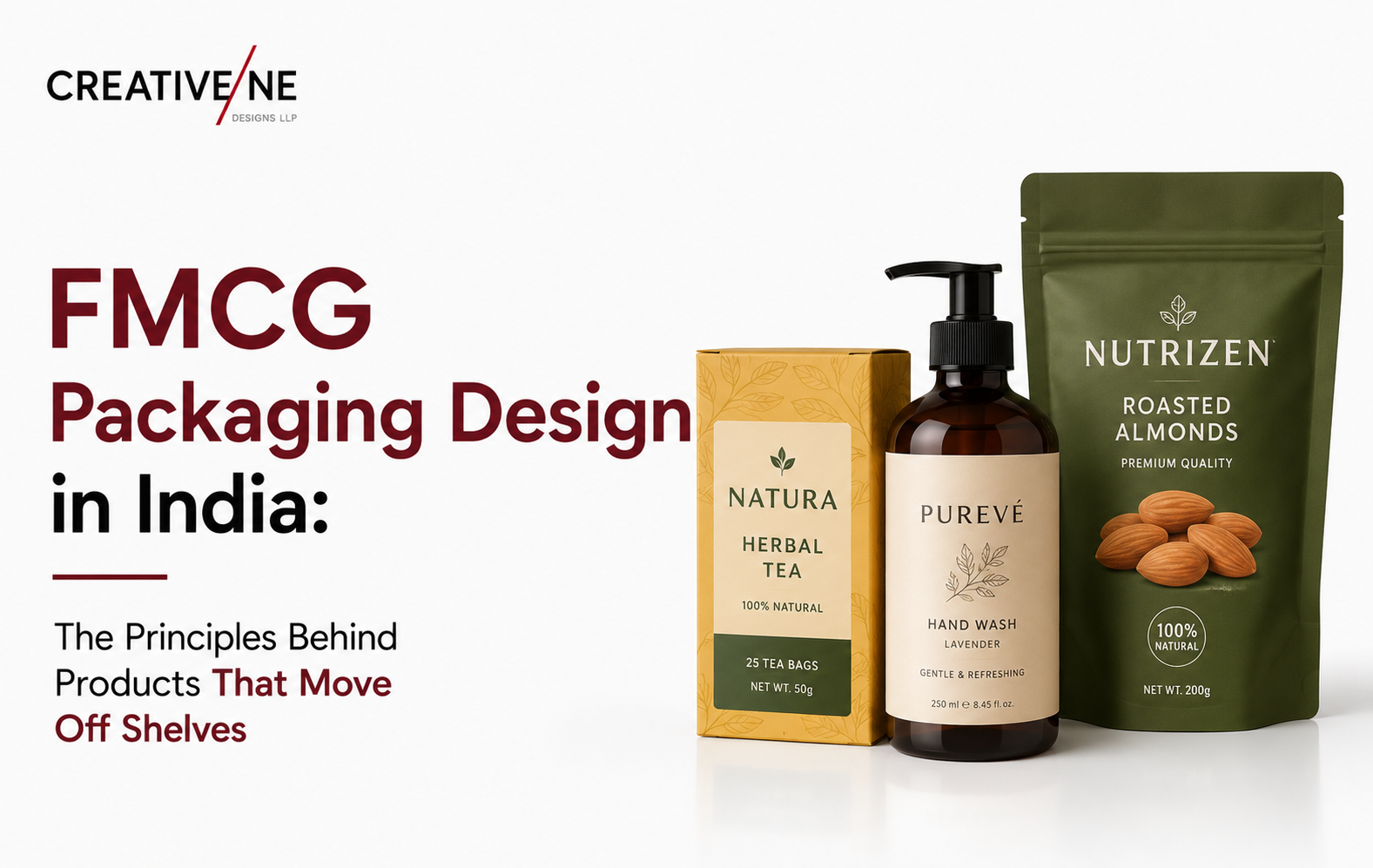
India’s organised FMCG sector is valued at over Rs. 5 lakh crore and growing at 8 to 10 percent annually. The modern Indian retail shopper encounters over 40,000 individual SKUs in a single store visit and consciously evaluates fewer than 100. In this environment, a packaging design company that understands FMCG shelf dynamics – not just visual aesthetics – is the difference between a product that earns trial and one that sits behind a stronger visual competitor. FMCG packaging is not decoration. It is the primary mechanism by which a product stops a shopper, communicates its value, and converts a browser into a buyer, entirely without human sales involvement.
Why FMCG Packaging Demands a Different Design Approach
Premium D2C brands and luxury products design packaging for a considered purchase environment – a shopper who is already interested and spending time. FMCG operates in an entirely different context. A Rs. 30 masala pack, a Rs. 50 soap, or a Rs. 20 biscuit competes for a reflexive, habitual purchase decision made in under three seconds. The shopper is not deliberating – they are pattern-matching against familiar visual cues while walking past the aisle. This is a fundamentally different design problem from premium or artisanal packaging.
The Four Jobs of FMCG Packaging Design
Job 1 – Stop the Shopper
The first job is pure shelf differentiation – the packaging must stand out visually from the products immediately surrounding it on the retail planogram. This does not always mean brighter or louder; sometimes it means being the only calm, white-space-driven design in an aisle full of saturated colour. The visual strategy must be developed after analysing the full competitive facing, not in isolation.
Job 2 – Communicate the Offer in Two Seconds
Within the first scanning glance, the packaging must communicate: category (what is this?), brand (who makes it?), and variant or key benefit (which version, and why this one?). Everything else – ingredients, nutritional info, brand story – is secondary information that supports a decision already in progress. The front panel hierarchy must place these three elements above everything else.
Job 3 – Build Brand Recall
Repeat purchase is the engine of FMCG profitability. A design distinctive enough to be recalled from a single purchase encounter – without the shopper consciously trying to remember it – has compounding commercial value over time. Distinctive brand assets (a specific colour, a character, a proprietary graphic shape) serve this function and must be developed as deliberate design decisions, not incidental outcomes.
Job 4 – Convert Browsers to Buyers
Trust signals, value communication, and benefit claims placed at the right visual hierarchy level convert a shopper who has stopped and scanned into one who places the product in the basket. All four jobs must be served by a single coherent design – not as separate design exercises applied to different parts of the label.
Colour Strategy for FMCG Products in India
Colour is the fastest brand signal in FMCG – it communicates category membership, positioning, and brand personality before the shopper reads a word. Indian FMCG colour conventions by category:
- Natural and organic products: greens, earthy browns, white – signals clean, safe, natural origin
- Spices and traditional foods: reds, oranges, yellows, gold – signals bold flavour, authenticity, warmth
- Dairy and nutrition: blues and whites – signals purity, freshness, protein associations
- Personal care: pastels and soft neutrals for skincare; bold saturated colours for value personal care
- Household cleaning: high-contrast primary colours – signals efficacy and action
- Health supplements: blacks, dark blues, and metallics – signals premium and performance
The visual mechanisms that determine whether a product is noticed in a competitive retail aisle – colour contrast, label density, focal point design – are covered in detail in the context of shelf standout design principles, where the full planogram context drives the differentiation strategy rather than the aesthetic preferences of the designer or brand owner.
Typography and Information Hierarchy for FMCG Labels
FMCG label typography must solve two competing demands: brand personality expression, which calls for distinctive and characterful typefaces, and legibility at shelf distance, which calls for clean, high-contrast letterforms. The solution is a clear hierarchy. The brand name uses the expressive, personality-driven typeface – it must be remembered. The product name and variant use a highly legible typeface – they must be understood at a glance. Compliance information uses a standard, compact typeface – it must be present but does not need to be the first thing noticed.
Packaging System Design for FMCG Brands: SKU Range Architecture
Most FMCG brands launch with multiple SKUs simultaneously or add variants rapidly after market entry. Designing a single SKU without a range architecture is a common and expensive mistake – the brand must redesign when adding a second flavour or size because the first design was not built to accommodate a range.
A well-designed FMCG packaging system defines: the fixed brand elements constant across all SKUs (logo, primary colour block, brand typography), the variable elements that distinguish variants (flavour colour, variant descriptor, illustration), and the size architecture (how labels scale across pack sizes without losing proportion or legibility). Range ‘blocking’ – how multiple SKUs of the same brand look displayed together on a shelf – should also be designed intentionally, not left to chance.
FMCG Packaging for E-commerce and Quick Commerce Platforms
India’s quick commerce platforms and marketplace FMCG stores have created a second display context that packaging must perform in. The same consumer purchase triggers that operate in physical retail – colour pattern recognition, hierarchy scanning, and focal point response – operate at thumbnail scale on Blinkit, Zepto, and Amazon Pantry, where the margin for subtlety is even smaller than in a physical aisle.
FSSAI labelling requirements apply equally to physical retail and e-commerce sales. The FSSAI food labelling regulations specify the mandatory elements, minimum font sizes, and nutritional disclosure formats that must be present on every FMCG food product label – non-compliance risks regulatory action and removal from retail and marketplace listings.
Launch Your FMCG Product with Retail-Ready Packaging – from Creativeline
Creativeline designs FMCG packaging for Indian consumer goods brands – from single SKU launches to complete product range systems, with shelf impact, range architecture, and FSSAI compliance built in from the brief stage.
Quick Shelf-Impact Checklist for FMCG Packaging
Shelf impact is how quickly a pack earns attention in a crowded aisle. Shoppers make many decisions at the point of sale, often in a few seconds, so use this checklist before approving any FMCG packaging design:
- Contrast against the category: place your mockup next to the top five competitors. If it blends into the dominant category colour, it will be hard to spot.
- Instant brand recognition: the logo and brand colour should sit in the same position across every SKU so repeat buyers find you faster.
- Honest product representation: photography or illustration should show the product accurately. Good visuals help, but misleading ones lead to disappointment and returns.
- Perceived quality: buyers often judge product quality by pack quality, so check print finish, material feel and colour accuracy on a physical proof.
- Distance test: view the pack from two to three metres away and on a phone screen at thumbnail size. The product name and variant should still be clear.
- Retail and online roles: the same pack drives impulse buying on the shelf and shapes the unboxing experience for D2C orders, so design for both.
FAQs
Q1. How much does FMCG packaging design cost in India?
A: A single SKU FMCG label design costs between Rs. 10,000 and Rs. 60,000 depending on pack complexity, illustration requirements, and whether brand system architecture is included. A range system for 5 to 10 SKUs typically costs Rs. 50,000 to Rs. 2,00,000.
Q2. What are the FSSAI labelling requirements for FMCG food products in India?
A: FSSAI mandates: product name, net quantity, ingredient list in descending order, nutritional information per 100 g or 100 ml, allergen declaration, FSSAI licence number, manufacturer and marketer address, country of origin, best before date, and lot/batch number. Minimum font size requirements apply to mandatory elements.
Q3. What makes FMCG packaging design different from premium packaging?
A: FMCG packaging operates in a reflexive purchase environment where decisions are made in under three seconds. Premium packaging serves a considered purchase where the buyer is already engaged. FMCG design prioritises shelf differentiation, category signal clarity, and brand blocking above storytelling and premium material cues.
Q4. How do I design packaging for a new FMCG product launch in India?
A: Start with a competitive shelf audit – photograph the products your brand will sit alongside and analyse their colour, typography, and design language. Define your brand’s positioning within that competitive space. Brief an agency on the range architecture, not just the first SKU, to avoid redesign when adding variants.
Q5. How should FMCG packaging work for both retail and online marketplaces?
A: Design the front panel to work at two scales: full physical pack size for retail and 200×200 pixel thumbnail for e-commerce. The brand name and product variant must be legible at thumbnail scale. Test every design at both scales before approving print production.
Q6. How long does FMCG packaging design take from brief to print-ready files?
A: A single SKU label design takes 10 to 15 working days from approved brief. A range system for 5 to 8 SKUs takes 4 to 6 weeks. FSSAI compliance review, dieline procurement, and colour proof approval add 5 to 10 working days and should be planned into the launch schedule.
Q7. What is SKU range packaging design and when is it needed?
A: Range packaging design creates a coordinated visual system for multiple product variants – different flavours, sizes, or product lines under the same brand. Any brand launching more than one SKU simultaneously, or planning range extensions within 12 months, should commission range architecture design from the first project to avoid costly redesign later.
