
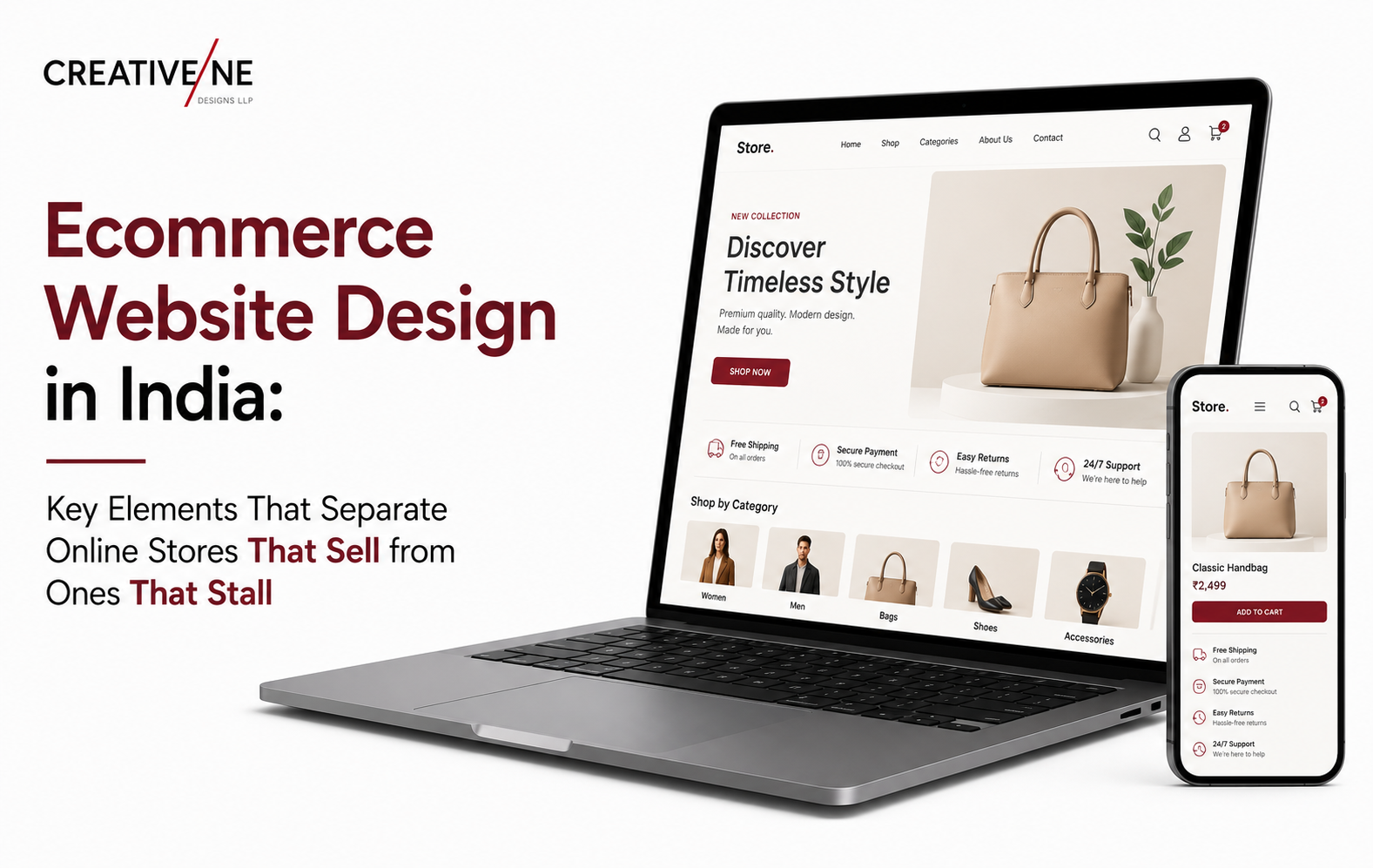
India’s D2C e-commerce market crossed Rs. 55,000 crore in 2024. Brands like Mamaearth, The Moms Co., and Wow Skin Science built large businesses on their own websites before expanding to marketplaces. What they have in common is not just product quality – it is web UI/UX design that converts. A website built on a generic theme with no conversion architecture loses the majority of paid traffic before a single transaction. The design decisions made at the store-build stage – not the advertising or the product – determine whether a D2C brand’s paid campaigns are profitable or expensive and invisible.
Why Ecommerce Design Is Different from General Website Design
A general website has multiple goals – inform, build trust, generate enquiries, showcase work. An ecommerce website has one: complete a transaction. Every design decision must be evaluated against this single objective. A beautiful hero image that slows page load by two seconds is a bad design decision. An elegant five-level navigation is a bad design decision. A minimal product page that does not show the product from enough angles is a bad design decision.
India’s ecommerce context adds specific requirements that global design guidelines do not account for. Over 70 percent of Indian ecommerce sessions happen on mobile networks with variable speed. Price sensitivity is high – the value proposition must be communicated faster and more clearly than in markets where brand trust is assumed. COD is still a significant payment preference in tier-2 and tier-3 cities, and trust signals that reassure first-time buyers have outsized conversion impact.
The 7 Design Elements Every Indian Ecommerce Website Must Have
1. A Homepage That Communicates What You Sell in 5 Seconds
The hero section must answer three questions before the first scroll: What does this store sell? Why is it worth buying here? What is the first action? A hero with a lifestyle image and a tagline like ‘Crafted with Love’ answers none of these. A hero that shows the product, states the key differentiator (organic, dermatologist-tested, sugar-free), and has a prominent CTA answers all three.
2. Category Pages That Enable Scanning
Indian online shoppers browse category pages quickly, looking for something that catches the eye. Filter and sort functionality is non-negotiable for stores with more than 12 SKUs. Product card design must show image, name, price, and a variant indicator – without requiring a click into the product page to get basic information.
3. Product Pages That Do the Selling
The product page is the highest-conversion real estate on any ecommerce website. It must include: minimum four images from multiple angles, product name with variant clearly specified, price with any discount communicated visually, a primary CTA above the fold on mobile, key benefits as scannable bullet points, customer reviews with rating count, and trust badges near the CTA – not in the footer.
4. Mobile Navigation Built for Thumb Reach
Over 70 percent of Indian ecommerce sessions are on mobile. Navigation must work within the thumb reach zone – the natural sweep area of a right thumb on a phone held one-handed. Dropdowns with hover states do not exist on mobile. Category trees requiring three taps to reach a product lose shoppers at each tap. Headers consuming more than 15 percent of the mobile viewport reduce the visible product content area on the most important screen real estate.
5. Checkout with Maximum Three Steps
Every additional step in checkout reduces conversion. The Indian ecommerce checkout should have a maximum of three screens: cart review, address and payment, and order confirmation. Guest checkout must be available – forcing account creation before purchase is one of the most common conversion killers. UPI, Net Banking, COD, and EMI options must all be visible at the payment step without additional clicks.
6. Trust Signals at Decision Points
Indian first-time buyers are trust-sensitive. Delivery timeline, easy returns policy, authentic product guarantee, and secure payment badges must be visible near the Add to Cart button – not buried in the footer. Social proof (review count, customer count, media mentions) is particularly effective for new brands that do not yet have wide recognition.
7. Speed: 2 Seconds or Less on 4G
53 percent of mobile site visits are abandoned if a page takes more than 3 seconds to load. On India’s variable mobile speeds, 2 seconds is a more practical target. Images must be compressed and delivered in WebP format. Above-the-fold content must load before below-the-fold elements. Every decorative animation that adds load time costs real conversion.
Product Photography and Its Impact on Product Page Conversion
The most common ecommerce design failure in India is not layout or navigation – it is product imagery. A well-structured product page with poor photography converts at a fraction of its potential. The direct relationship between photography and sales conversion is consistent across categories: high-quality images reduce purchase hesitation, reduce return rates, and increase average order value. For an Indian ecommerce website, each product needs a minimum of four images – main shot, two angle shots, and one lifestyle or in-use image.
Platform Choice and Its Design Implications
Shopify India offers a managed platform with strong built-in checkout optimisation – theme customisation gives significant design control while maintaining performance. WooCommerce offers maximum design flexibility but requires more active performance management. Custom development gives complete control but requires a dedicated development and maintenance relationship. The design performance principles are consistent regardless of platform.
The technical connection between design decisions and website performance and SEO – Core Web Vitals, image optimisation, render-blocking scripts – matters as much for ecommerce as for any other website type and directly affects both organic search rankings and the user experience that determines whether a paid visitor converts.
Build an Ecommerce Website That Converts – with Creativeline
Creativeline designs ecommerce websites and product pages for Indian D2C and FMCG brands – mobile-first UI, conversion-optimised product pages, fast-loading architecture, and trust-signal placement built in from the start.
FAQs
Q1. How much does ecommerce website design cost in India?
A: Ecommerce website design costs between Rs. 30,000 for a Shopify or WooCommerce theme customisation and Rs. 3,00,000 to Rs. 8,00,000 for a fully custom-designed online store. Design fees are separate from development, hosting, payment gateway integration, and marketing costs.
Q2. What is the best platform for ecommerce websites in India?
A: Shopify suits brands that want a managed solution with faster setup and built-in checkout optimisation. WooCommerce suits brands already on WordPress needing maximum plugin flexibility. Both platforms can be designed to the same visual and conversion standard – the right choice depends on your team’s technical capacity and long-term roadmap.
Q3. How long does it take to design and launch an ecommerce website in India?
A: A well-designed ecommerce website takes 4 to 8 weeks from brief to launch, covering UI/UX design, front-end development, product catalogue setup, payment gateway integration, and basic SEO. Complex functionality like subscriptions or B2B portals adds 4 to 12 more weeks.
Q4. What should an ecommerce product page design include?
A: Minimum four product images, product name with variant, price with offer visibility, Add to Cart and Buy Now buttons above the fold on mobile, benefits as bullet points, customer reviews with rating count, trust badges near the CTA, shipping and returns information, and related product recommendations.
Q5. How do I make my ecommerce website mobile-friendly in India?
A: Mobile-friendliness means: pages loading within 2 to 3 seconds on 4G, navigation working within thumb reach zones, product images zooming without breaking the layout, checkout forms with auto-fill support, and UPI payment options integrated at the checkout step. Test on actual mid-range Android devices, not desktop browser emulators.
Q6. What are the most important trust signals on an Indian ecommerce website?
A: The highest-impact trust signals are: easy 7-day return policy near the CTA, COD option availability, customer review count and average rating, number of orders or happy customers, genuine product verification for health and wellness products, and recognisable payment method logos (UPI, Razorpay secure badge).
Q7. Can better website design increase ecommerce sales without changing the product?
A: Yes. Conversion rate optimisation through improved design – better product images, clearer CTA placement, streamlined checkout, stronger trust signals – consistently produces 20 to 80 percent lift in conversion rate without changing the product or pricing. For a store driving paid traffic, this directly multiplies revenue from the same ad spend.
