
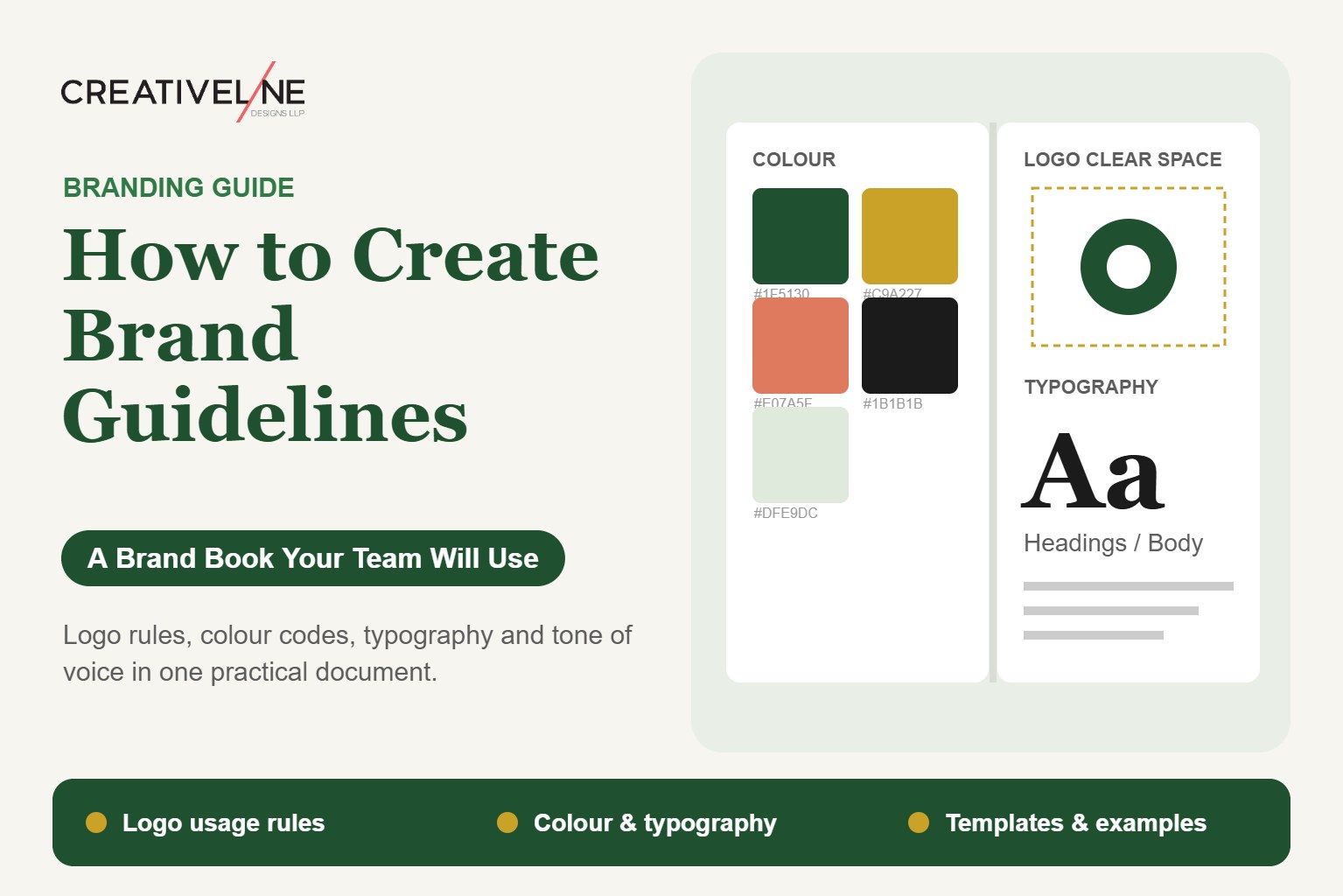
Most growing businesses in India reach a point where the logo looks slightly different on every banner, the Instagram posts use five fonts and the new packaging does not quite match the website. The fix is a clear set of brand guidelines: a practical rulebook that shows everyone, from your in-house team to printers and agencies, how the brand should look and sound. If your identity is still being built, start with professional logo and brand identity design, then document it so it stays consistent.
This guide explains what a brand book should include, how to create them step by step, and how to make sure they are used instead of forgotten in a shared drive.
What Are Brand Guidelines?
Brand guidelines, also called a brand book, brand manual or brand style guide, are a document that defines how your brand is presented. They cover visual elements such as the logo, colours and typography, and verbal elements such as tone of voice and key messages.
The purpose is simple: anyone who creates something for your brand should be able to produce work that looks and sounds like you, without needing the founder to approve every detail.
Why a Brand Style Guide Matters for Growing Businesses
- Consistency builds recognition. When customers see the same colours, type and style everywhere, they remember you faster.
- Faster work. Designers, printers and social media teams spend less time guessing and fewer rounds on revisions.
- Easier outsourcing. A new agency or freelancer can get up to speed from one document.
- Protection of your investment. A well-designed identity loses value quickly if it is stretched, recoloured or misused.
What to Include in Your Brand Guidelines
A good brand manual is complete but not bloated. For most small and mid-sized Indian businesses, these sections cover what matters.
1. Brand Foundation
A short page on your purpose, positioning, audience and personality. This gives context for every design and writing decision that follows.
2. Logo Usage
- Primary logo and approved variations such as horizontal, stacked and icon-only versions.
- Clear space around the logo and minimum sizes for print and screen.
- Approved colour versions: full colour, single colour, and reversed on dark backgrounds.
- Examples of misuse: stretching, adding effects, changing colours or placing it on busy images.
3. Colour Palette
List primary and secondary colours with exact values for each use: HEX and RGB for screens, CMYK for print, and Pantone references where you use spot colours. Show the proportion of each colour so the palette is used as intended, not just listed.
4. Typography
Specify the typefaces for headings, body text and supporting text, with sizes, weights and fallback fonts for tools like email and presentations. If your brand communicates in Hindi, Gujarati or another Indian script, include matching fonts for those scripts too.
5. Imagery and Graphic Elements
Describe the photography style, lighting and subject matter, along with illustration style, icons, patterns and any graphic devices that make your brand recognisable.
6. Tone of Voice
Explain how the brand sounds, with do and don’t examples. A premium skincare brand and a local snack brand should not write the same way.
7. Applications
Show the rules in action: business cards, social media templates, packaging, signage, website headers and presentations. Examples teach faster than rules.
How to Create Brand Guidelines Step by Step
- Audit what exists. Collect every logo file, brochure, social post and pack currently in use. Note inconsistencies.
- Confirm the core identity. Decide which logo, colours and fonts are final. If the identity itself is weak, fix it before documenting it.
- Define the rules. Write down usage rules for each element, with clear measurements and values.
- Design real examples. Create templates and mockups for the channels you actually use.
- Test with users. Give a draft to a designer or team member and ask them to create something using only the document. Gaps show up quickly.
- Package the files. Deliver the guideline PDF with an organised asset kit: logos in vector and PNG formats, font licences and templates.
- Assign an owner. Someone should be responsible for updating the document as the business evolves.
Making Brand Guidelines Accessible and Practical
A 60-page PDF that nobody opens does not protect your brand. A practical brand book is:
- Short where possible. A focused 15 to 25 page document is often enough for a growing business.
- Easy to find. Keep one current version in a shared folder, with a one-page quick reference for everyday use.
- Accessible. Check that text and background colour combinations have enough contrast to be readable. The W3C Web Content Accessibility Guidelines (WCAG) are a useful reference for digital colour contrast.
- Template-led. Ready-made Canva or Figma templates for social posts and presentations make it easy for non-designers to stay on brand.
A brand style guide is the final layer of a wider identity system that starts with strategy, logo, colour and typography. If you want to understand how those elements are built in the first place, read our complete guide to brand identity design for Indian businesses.
Common Brand Guidelines Mistakes
- Documenting a weak identity instead of fixing it first.
- Listing colours without CMYK or print values, which leads to colour shifts on packaging.
- Skipping real examples, so teams interpret the rules differently.
- Never updating the document after new products, channels or sub-brands are added.
- Sharing only a PDF without the actual logo files and templates.
Frequently Asked Questions
What is the difference between brand guidelines and a brand style guide?
In everyday use the terms mean the same thing. Some teams use “style guide” for the visual rules only, while “brand guidelines” or “brand book” also includes positioning and tone of voice.
How many pages should a brand book have?
There is no fixed number. Many small and mid-sized businesses manage well with 15 to 25 pages, while large brands with many sub-brands may need much more.
Can I use a brand guidelines template?
A template can help with structure, but the content must reflect your actual identity. Copying another brand’s rules without adapting them usually creates confusion.
When should brand guidelines be updated?
Review them when you launch new products, enter new channels, rebrand or notice that teams are regularly working around the rules. An annual review is a good habit.
Conclusion
Brand guidelines turn a good identity into a consistent brand. Keep them focused, include real examples, provide the right files and give someone ownership of updates. Done well, they save time on every project and make your business look as professional on a printed box as it does on Instagram.
