
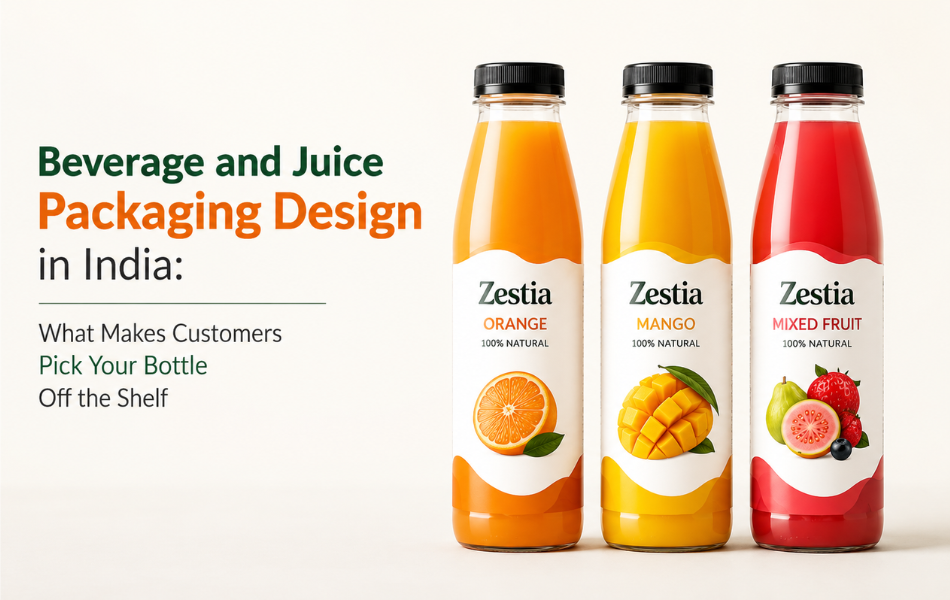
India’s organised beverage market is worth over Rs. 25,000 crore and expanding at 12 to 15 percent annually. Every major retail chain – from D-Mart and Reliance Smart to neighbourhood kiranas – stocks dozens of competing juice, drink, and water brands at every price point. A shopper standing at a chiller makes a selection in under three seconds, based almost entirely on what the packaging communicates at first glance. For new and growing beverage brands in India, the packaging design company a brand chooses at concept stage – before printing, before launch – determines whether the product earns attention on the shelf or disappears behind a stronger visual competitor.
Why Beverage Packaging Is a Different Design Problem
Beverages present packaging challenges most other categories do not. The container is often transparent or semi-transparent, which means the liquid itself becomes part of the visual presentation and interacts directly with the label design. Cylindrical bottle surfaces limit the flat label area, requiring tighter information hierarchy than a flat carton face allows. Condensation affects ink adhesion and paper stock choice. And tamper-evidence elements must be integrated without cluttering the brand visuals.
The stakes are higher on the shelf too. Beverages are impulse purchases in most categories. A juice, flavoured water, or energy drink brand has no relationship with the shopper before the shelf moment. The packaging must build trust, communicate the flavour or benefit, and trigger the purchase – entirely through design, in under three seconds.
Key Design Elements of High-Performing Beverage Packaging
Label Layout and Information Hierarchy
The front label of a beverage package must communicate brand name, product type, and key variant – flavour, function, or format – within the first visual scan. Supporting information like ingredients and nutritional data belongs on the back or side panels. Brands that try to put everything on the front panel lose clarity and visual impact. The front label should answer three questions in two seconds: What is it? Which variant? Is it for me?
Colour Psychology for Drink Categories
Green communicates natural and health-oriented – most juice and wellness drink brands. Red signals bold and energetic – dominant in sports drinks and colas. Black and gold denote premium positioning – craft beverages, speciality teas, luxury water. Blue signals clean and hydrating – most bottled water brands. Breaking category colour conventions can differentiate, but requires sufficient brand recognition to prevent the product being misidentified as a different category. New beverage brands are almost always better served by clearly signalling category membership through colour first, then differentiating within that space.
Typography for Readability at Refrigerator Distance
Beverage labels are read from roughly 50 to 80 centimetres – not from a hand-held position. Brand name typography must be legible at that distance: clean, high-contrast letterforms with sufficient weight. Decorative or script fonts that work beautifully on a printed mockup often become illegible when viewed across a shelf in normal retail lighting. A practical test: print the label at actual size, tape it to a bottle, and read it from a metre away before approving.
Popular Packaging Formats for Beverages in India
- PET bottles – juice, water, flavoured drinks; the most common retail format
- Tetrapak and gable-top cartons – UHT juices, dairy beverages, long-shelf-life products
- Stand-up pouches – coconut water, health drinks, energy formats; growing in e-commerce
- Glass bottles – premium and artisanal brands, craft sodas, imported-style beverages
- Aluminium cans – cold beverages, RTD coffee, energy drinks targeting urban retail
- Sachet format – instant drink mixes, traditional sharbat brands, rural distribution channels
FSSAI Labelling Requirements for Beverage Brands
Every beverage sold in India must comply with mandatory label requirements before going to market. The FSSAI labelling regulations specify: brand name, common product name, net content, ingredients in descending order of weight, nutritional information per 100 ml, allergen declarations, FSSAI licence number, manufacturer address, best before date, and batch number. Minimum font size requirements apply to each mandatory element – designs placing mandatory information below the minimum size fail regulatory review before reaching retail.
Integrating FSSAI mandatory elements without cluttering the design is a specialist skill. The information hierarchy must satisfy both the regulatory requirement – mandatory elements present and legible – and the commercial objective – brand and product communication not buried under compliance text.
Design Trends Shaping Beverage Packaging in India 2025
The shift in visual direction is visible across FMCG. The same forces driving food packaging trends – minimalism, transparent window elements, bold typographic statements, and sustainability cues – are crossing into India’s juice and drinks category at increasing speed, particularly in premium and health beverage segments. For mass-market products targeting price-sensitive shoppers, maximalist label design with vibrant colour and dense benefit claims continues to outperform on actual retail shelves.
Common Beverage Packaging Design Mistakes
The most expensive mistake in beverage packaging is designing for a printed mockup rather than for the actual retail environment. A label that looks striking in a digital presentation may read as generic on a refrigerator shelf surrounded by fifteen competing bottles. Beverages sit in the impulse purchase category, where the principles governing packaging buying behaviour are at their most direct – where colour, hierarchy, and focal point must do the entire job of stopping a shopper who is not yet looking for your product.
- Overcrowded front panels with too many competing benefit claims
- Colour choices that photograph poorly as small thumbnails on Blinkit, Zepto, or Amazon
- Inconsistent brand elements across pack sizes – 200 ml and 1 litre should read as the same brand
- Not testing the label at actual print scale on a bottle before approving production print
Designing for Retail and Quick Commerce Simultaneously
India’s quick commerce platforms have created a second display context for beverage brands. Product thumbnail images at 300×300 pixels must communicate brand and variant instantly. A highly illustrated label that reads well at bottle size may lose all legibility as a small product card. Leading Indian beverage brands now run a thumbnail test as part of the sign-off process – the design must perform at retail scale and at digital shelf scale before print approval.
Design Beverage Packaging That Wins at Retail and Online – with Creativeline
Creativeline designs beverage and juice packaging for Indian FMCG brands – from label concept to print-ready files, with FSSAI compliance built in and shelf-impact testing included.
Frequently Asked Questions
Q1. How much does beverage packaging design cost in India?
A: Beverage label design in India costs between Rs. 8,000 and Rs. 50,000 depending on design complexity, number of panels, format type, and whether FSSAI compliance review is included. A basic single-SKU bottle label falls in the Rs. 8,000 to Rs. 20,000 range.
Q2. What are the FSSAI labelling requirements for juice packaging in India?
A: Every juice label must display: product name, net content, complete ingredient list, nutritional information per 100 ml, allergen declarations, FSSAI licence number, manufacturer address, best before date, and batch number. Minimum font size requirements apply to each mandatory element.
Q3. What file format is needed for beverage label printing in India?
A: Print vendors require PDF, AI, or EPS with fonts embedded or converted to outlines, CMYK colour mode, and minimum 300 DPI for raster elements. RGB files produce colour shifts at print and are not acceptable for final production.
Q4. How do I design packaging for a new juice brand in India?
A: Start with a brand brief: define your target shopper, price positioning, key differentiator, and the one thing the pack must communicate at first glance. Develop concepts before going into detailed design. Always test the final design at printed label scale on an actual bottle, viewed from refrigerator distance, before approving production print.
Q5. What colour combinations work best for juice and beverage packaging?
A: Fresh and natural juice brands perform with greens, warm yellows, and fruit-illustration palettes. Premium beverages use black, gold, or white with minimal illustration. Kids’ beverages use bright primaries with character-driven design. Mass-market value brands use high-saturation colours with maximum contrast.
Q6. Can the same packaging design work for retail shelves and online quick commerce?
A: It should – but must be tested at both scales. The front label must read clearly as a bottle on shelf and as a 300×300 pixel thumbnail. If fine typography or detailed illustration disappears at thumbnail scale, the design needs a digital optimisation pass before final print approval.
Q7. How long does beverage packaging design take from concept to final files?
A: A standard beverage label – one SKU, single format – takes 7 to 12 working days including concept, revision rounds, and final file delivery. A full range system with multiple variants and formats takes 3 to 5 weeks.
