
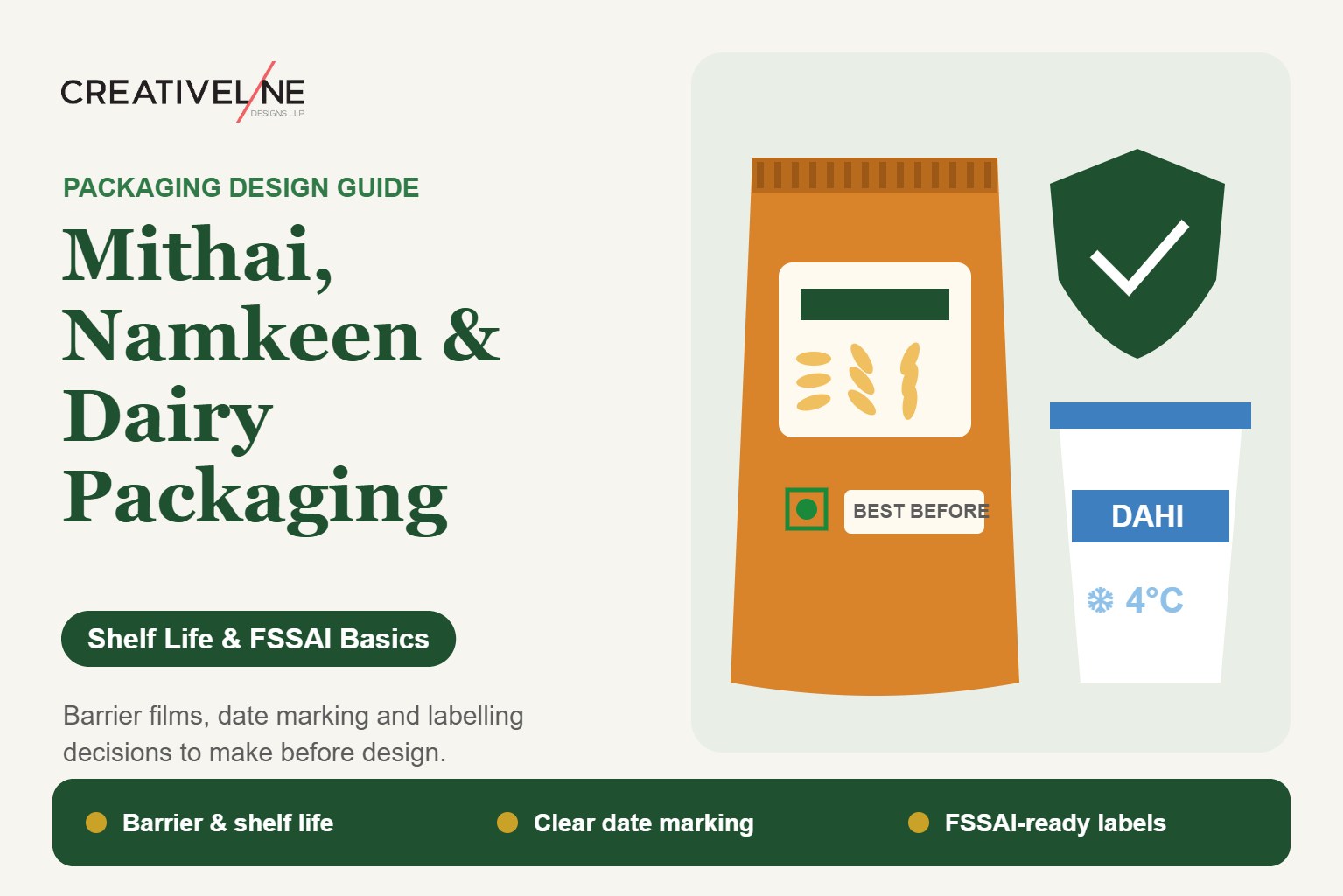
Spices, seeds, beverages, supplements, cosmetics, chocolate. Most major FMCG categories in India have a well-worn packaging playbook by now. Mithai, namkeen, and dairy sit in an odd gap. They’re some of the most widely bought food categories in the country. Yet mithai and namkeen packaging still gets treated as an afterthought, a printed box because “that’s what everyone uses,” not a decision based on shelf life, moisture, or gifting.
That gap costs more than it looks like on paper. A namkeen packet that goes stale two days early, because the barrier film wasn’t right. A mithai box that looks fine on a shelf but forgettable during Diwali, when every rival box is fighting for the same eye. These are packaging decisions, not bad luck.
Table of Contents
- Why this category needs its own approach
- Shelf life and moisture: where namkeen packaging starts
- Festive demand and shelf life
- Regional naming and labelling
- FSSAI labelling for dairy and sweets
- Dairy-specific packaging considerations
- Common mistakes in this category
- FAQs
Why This Category Needs Its Own Approach
Most FMCG packaging guides are written for shelf-stable products at room temperature. A bag of chips. A bottle of sauce. A jar of pickle. Mithai, namkeen, and dairy break that pattern in three ways at once.
They’re often short shelf life or perishable, which changes what the packaging material has to do, not just how it looks. They carry strong regional and festival ties that generic FMCG packaging doesn’t need to account for. And dairy, specifically, follows cold-chain and FSSAI rules that don’t apply to a bag of namkeen on a dry-goods shelf.
Treat this category with a generic brief, “make it look premium, add gold foil,” and you’ll miss the decisions that actually decide whether the product survives the trip from factory to customer in good shape.
Shelf Life and Moisture: Where Namkeen Packaging Starts
Namkeen packaging is the clearest example. It’s fried, often oil-rich, and very sensitive to moisture and oxygen. Both cause it to go soggy or rancid well before most customers would call it expired. The namkeen packaging decision that matters most here isn’t the artwork. It’s the barrier film.
A few things worth getting right in namkeen packaging, and across the category, before design even starts.
Moisture and oxygen barrier. Metallised film or laminated pouches with a real barrier extend shelf life more than a plain single-layer plastic pouch. This is a materials decision that has to happen before the design brief, since it shapes the pouch structure and how printing sits on the film.
Nitrogen flushing for oil-rich products. Common in premium namkeen packaging. It pushes oxygen out of the sealed pack, which slows rancidity. This is a format decision, not a design one, but your designer needs to know about it, since it can affect pouch shape and seal design.
Mithai’s shorter runway. Fresh mithai, especially milk-based sweets like barfi, peda, or rasgulla, often has a shelf life measured in days, not weeks. Packaging needs to show freshness clearly. Put the “best before” date on the front of the box, not buried in small print. Customers buying mithai are often buying for same-day gifting, and they’ll check.
Dairy’s cold-chain need. Packaged dairy, like paneer, curd, or flavoured milk, needs packaging built for cold storage. That means materials and seals that hold up in the fridge without failing, plus clear cold-chain instructions on the pack. A customer who leaves paneer out for a few hours, because the label wasn’t clear, ends up with a bad experience that isn’t really the product’s fault.
Festive Demand and Shelf Life
Festive seasons like Diwali and Raksha Bandhan multiply order volumes for mithai and namkeen, and that is exactly when shelf-life problems show up. Stock is produced earlier, stored longer and shipped further, so the barrier, sealing and date-marking decisions above matter even more in peak season.
A few practical checks before festive production runs:
- Confirm that barrier films and seals are rated for the longer storage time between production and sale.
- Plan date stickers or printing for high-volume batches, so every pack carries the correct best-before date.
- Keep milk-based sweets on short, clearly dated cycles, even when demand tempts you to produce further ahead.
This guide focuses on shelf life and compliance. For gift box structures, finishes and festive graphics, see our separate guide to sweet box design for Diwali gifting.
Regional Naming and Labelling
India’s mithai and namkeen naming isn’t standard the way “potato chips” is. The same product can carry different names in different regions. Packaging that only uses one pan-India name can undersell a product’s authenticity in a region where the local name carries more weight.
Two takeaways here. If you sell across several states, decide deliberately whether packaging uses one name everywhere or a local name per market. For products with real regional roots, calling that out directly on the pack, like “Gujarati-style” or the name of a specific town tied to the sweet’s history, is often a stronger sell than a generic pan-India label.
FSSAI Labelling for Dairy and Sweets
This is a compliance matter, not just a design one. Worth knowing before the brief is finalised. FSSAI (Food Safety and Standards Authority of India) rules generally require, at minimum:
- FSSAI logo and 14-digit licence number, printed clearly on the pack.
- Product name and full ingredient list, in order of quantity.
- Net weight or volume.
- Manufacturing date and expiry or best-before date. For dairy and fresh mithai, this needs to be easy to find, not just technically present.
- Manufacturer or packer name and full address.
- Nutrition information panel, in FSSAI’s current format.
- Storage instructions, especially important for dairy products needing refrigeration.
- Veg or non-veg symbol, the green or brown dot. This is mandatory, and often too small or placed poorly on small packet formats.
None of this is unusual. But it needs to be part of the layout from the start, not squeezed in once the design is “done.” A common cause of last-minute redesigns is finding out the required information panel doesn’t actually fit the space left for it.
(This is a general summary, not legal advice. Always confirm current rules against FSSAI’s official guidelines, or with a compliance consultant, before finalising packaging for production.)
Dairy-Specific Packaging Considerations
Beyond FSSAI labelling, dairy packaging raises a few extra questions worth deciding early.
Tamper-evidence. A seal that clearly shows if a pack has been opened matters more for dairy than most FMCG categories, given food-safety concerns and how often dairy sells loose alongside packaged options.
Clear-window vs. fully printed packaging. A clear window showing the product, common for paneer and curd cups, builds trust through visible freshness, but trades off branding space. Decide this on purpose, rather than defaulting to whatever the supplier offers as standard.
Condensation-resistant printing. Ink and adhesive that hold up in refrigerated, often damp conditions. A real, practical materials question a generic packaging designer without dairy experience might not think to raise.
Common Mistakes in This Category
A few patterns we see often.
- Treating namkeen packaging as a print job, when the barrier film matters more for actual shelf life.
- Skipping gifting packaging entirely, and using the same everyday carton year-round, missing the festival sales bump premium packaging often brings.
- Burying the expiry date in small print on short-shelf-life products, where customers actively look for it.
- Treating the FSSAI-required panel as an afterthought, leading to cramped, hard-to-read compliance text.
- Using one generic product name across regions with strong local naming, and losing an easy trust signal.
Planning a packaging refresh for your mithai, namkeen, or dairy brand? Design Packaging for Your Sweets or Dairy Brand, from Creativeline. We work with the shelf-life, gifting, and compliance needs specific to this category, not a generic FMCG template.
For related categories, see our guides to spices and masala packaging and FMCG packaging design in India.
FAQs
What’s the biggest namkeen packaging mistake brands make? Underinvesting in barrier film quality. Attractive print on a pouch that doesn’t control moisture and oxygen well leads to staleness complaints that customers blame on the product, not the packaging.
Does festive-season mithai need different packaging? The shelf-life and labelling basics stay the same, but festive stock is often stored longer and shipped further, so barrier materials, seals and clear date marking deserve extra attention during peak season.
Is FSSAI labelling different for dairy compared to namkeen or mithai? The core required fields are similar. Dairy carries extra expectations around storage instructions and clear expiry information, given how quickly it can spoil.
Should regional sweets use their local name or a standard pan-India name on packaging? It depends on your market. For brands selling mostly in one region, with a strong local identity for a product, the local name is usually a stronger trust signal than a generic pan-India label.
How much shelf life can good namkeen packaging actually add? It varies by product and oil content. Moving from a basic single-layer pouch to a proper barrier-laminated pouch, with nitrogen flushing for oil-rich products, is usually the single biggest improvement available.
Do small or homegrown mithai brands need FSSAI-compliant packaging too? Yes. FSSAI labelling rules apply based on business scale and registration category, not brand size. Confirm your specific compliance category early, rather than assuming it doesn’t apply.
Is clear-window packaging better than fully printed packaging for dairy products? Neither is always better. Clear windows build trust through visible freshness. Fully printed packs give more room for branding. The right choice depends on how much your brand relies on visual freshness cues versus branding impact on shelf.
Written By Creative Line
