
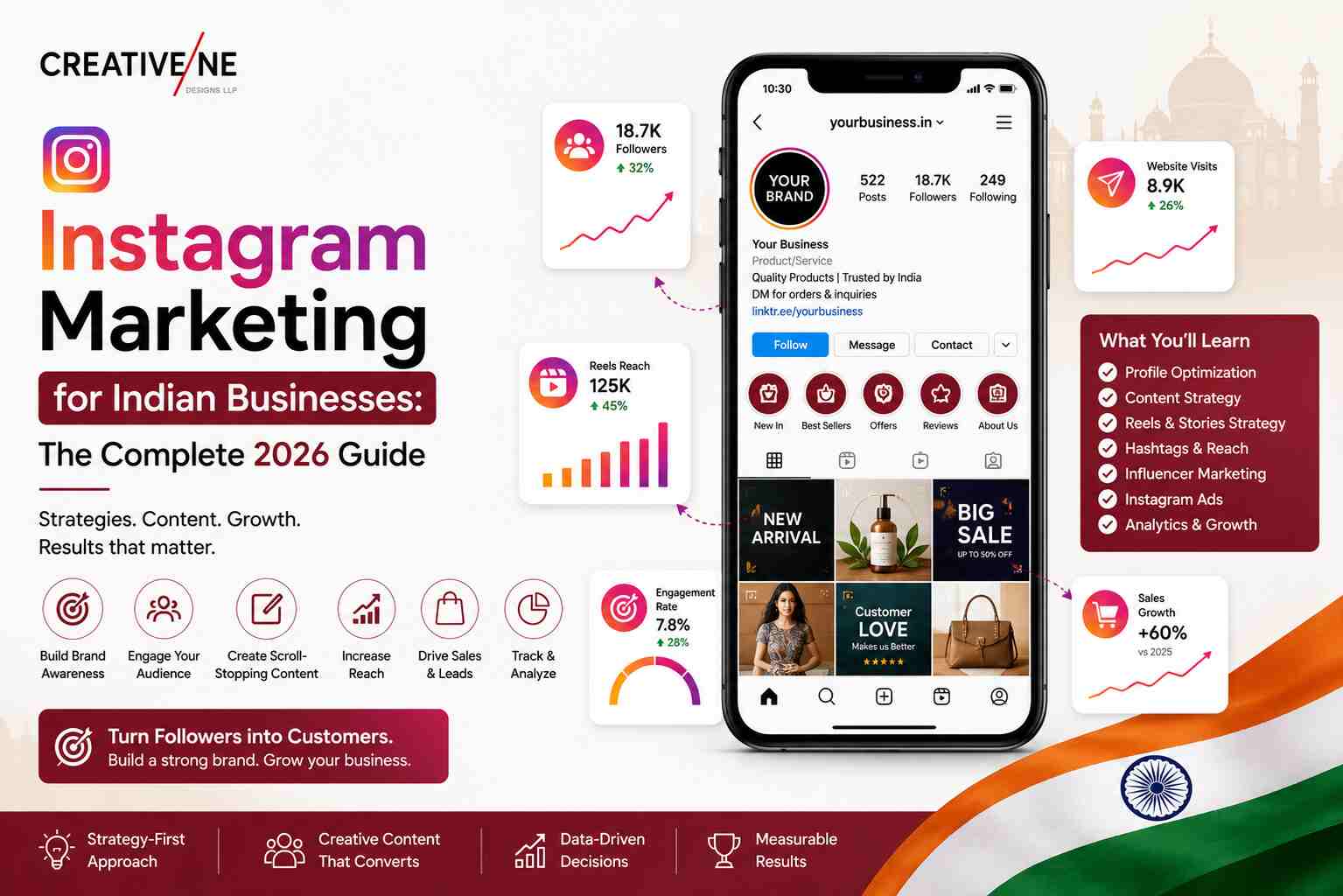
Instagram marketing for business is now a basic shopfront in India rather than a nice-to-have, because Instagram is where most Indian consumers discover brands they have never heard of — through a reel, a friend’s share, or a search for something they want to buy. This guide is a practical playbook: how to set up a profile that converts, what to post, how discovery actually works in 2026, and how to tell whether any of it is working.
Why Instagram Marketing for Business Works in India
Instagram marketing for business works unusually well in the Indian market, for three reasons. First, discovery is algorithmic — a small brand’s reel can reach people who have never heard of it, which is not true of most channels. Second, it is visual, so product categories like food, fashion, décor, and beauty sell natively. Third, the buying conversation happens in DMs, which suits how Indian customers prefer to enquire before purchasing.
The implication: Instagram is not only a branding channel for Indian SMEs, it is a genuine enquiry channel — provided the profile is built to convert and someone answers the messages.
Setting Up a Profile That Converts
- Switch to a business or creator account. Without it you have no insights and no ad tools.
- Write a bio that answers “what do you sell, to whom, where”. Clever taglines convert worse than clear ones.
- Use a searchable name field. Put your category in it — “Sharma Spices | Masala Manufacturer” — because that field is searchable.
- Add a clear action path. WhatsApp button, call button, and one link (or link page) that goes somewhere useful.
- Pin three posts that answer buyer questions. What you sell, why trust you, how to order.
- Set up highlights for products, reviews, process, and FAQs.
Most profiles lose customers here rather than in the content. Someone arrives from a good reel, cannot tell what you sell in five seconds, and leaves.
Content Strategy: What to Post and Why
Content is where Instagram marketing for business is won or quietly lost. Four formats do the work, and each has a different job.
Reels: The Growth Engine
Reels are how new people find you. Prioritise them: product-in-use clips, quick tips, behind-the-scenes at your factory or kitchen, before-and-afters, and customer moments. Hook in the first second, keep it under 30 seconds where possible, and add on-screen text since many watch on mute.
Carousels: The Save Driver
Carousels earn saves and shares, which signal value to the algorithm and keep working for weeks. Use them for explainers, comparisons, checklists, and case studies.
Stories: The Trust Builder
Stories reach people who already know you and convert them into customers: polls, questions, order updates, packing videos, customer messages (with permission). Post to stories on days you do not post to the feed, so you never fully disappear.
Content Pillars and the 80/20 Rule
Define four or five recurring themes — for a spice brand: recipes, sourcing, customer stories, product education, festivals. Keep roughly 80% of posts useful or entertaining and 20% directly promotional. Feeds that sell in every post stop being watched, which makes the selling posts worthless too. We covered why this planning layer matters in why content strategy matters in social media marketing.
Posting Frequency for Indian Businesses
Consistency beats volume, every time. A realistic, sustainable cadence:
| Business size | Feed posts | Reels | Stories |
| Small business / solo owner | 2–3 per week | 2 per week | 3–4 days per week |
| Growing SME | 3–4 per week | 3 per week | Daily |
| Established brand | 4–5 per week | 4–5 per week | Daily, multiple |
Choose the row you can sustain for six months, not the one that sounds impressive. Three months of steady posting outperforms three weeks of daily posting followed by silence — a pattern we listed among the signs a business needs a social media marketing company.
Hashtags and Instagram SEO in 2026
Discovery has shifted. Hashtags still help categorise content, but keyword search inside Instagram now does much of the work — people search “masala brand Ahmedabad” or “bridal lehenga Surat” the way they would search Google.
What to do about it: write captions containing the words customers actually search, put your category in your profile name field, add descriptive alt text to posts, and speak your keywords aloud in reels (captions are indexed). Use a focused set of 5–10 relevant hashtags mixing broad, niche, and local — not thirty generic ones.
Instagram Ads: A Starter Framework
Start simple and let data lead:
- Objective: message or lead campaigns for enquiries; traffic only if your website converts well.
- Creative: promote a post that already performed organically. Proven content spends better than new content.
- Audience: start with a tight interest and location set, then build lookalikes once you have data.
- Retargeting: run one always-on campaign to people who watched your videos or visited your profile. It is usually the cheapest enquiry you will ever buy.
- Budget: a modest daily amount held steady for at least three weeks beats a large burst over three days.
For realistic monthly budgets, see our social media marketing cost guide.
Measuring What Actually Matters
Follower count is the least useful number on the dashboard. Track instead: reach and how much of it is non-followers (discovery), saves and shares (content value), profile visits (interest), DMs and enquiries (intent), and finally sales attributed to Instagram, however roughly.
Review these monthly, not daily. Instagram results compound; daily checking mostly generates anxiety and reactive decisions.
7 Mistakes Indian Brands Make on Instagram
- Buying followers — it destroys engagement rate and therefore reach.
- Posting only promotions and price lists.
- Ignoring DMs and comments for days.
- Avoiding reels because “we are not video people”.
- Inconsistent branding that makes the grid look like five companies.
- No call to action, so interested people do not know how to buy.
- Quitting in month two, right before compounding begins.
DIY or Agency: When to Get Help
Run it yourself while you can post consistently, produce reels regularly, answer DMs quickly, and manage ads sensibly. When two or more of those slip for a month or more, output quality drops just as the algorithm punishes inconsistency — and that is the point where professional social media marketing services pay for themselves rather than adding cost.
Frequently Asked Questions
How often should a business post on Instagram?
Two to four feed posts and two to three reels per week is a realistic target for most SMEs, plus regular stories. Sustainability matters more than frequency.
How much do Instagram ads cost in India?
Ad spend is flexible, and many Indian SMEs start with a modest monthly budget while testing creative and audiences. Cost per result varies widely by category, targeting, and creative quality — measure your own cost per enquiry rather than relying on published averages.
Do hashtags still work on Instagram in 2026?
They help categorise content, but keyword-rich captions and searchable profile details now drive more discovery. Use 5–10 relevant hashtags rather than long generic blocks.
How long does it take to grow a business Instagram account?
Expect visible engagement improvement in 60–90 days of consistent, strategic posting, and dependable enquiries around months three to six.
Start With the Fundamentals
Instagram marketing for business comes down to five fundamentals: a clear profile, a sustainable posting rhythm, reels as your discovery engine, keyword-aware captions, and one always-on retargeting campaign. That is the entire playbook — the difficulty is not knowing it, it is keeping it running every week for six months.
If keeping it running is the part that keeps slipping, Creativeline manages Instagram for brands across Gujarat and India. See what a month with us looks like.
