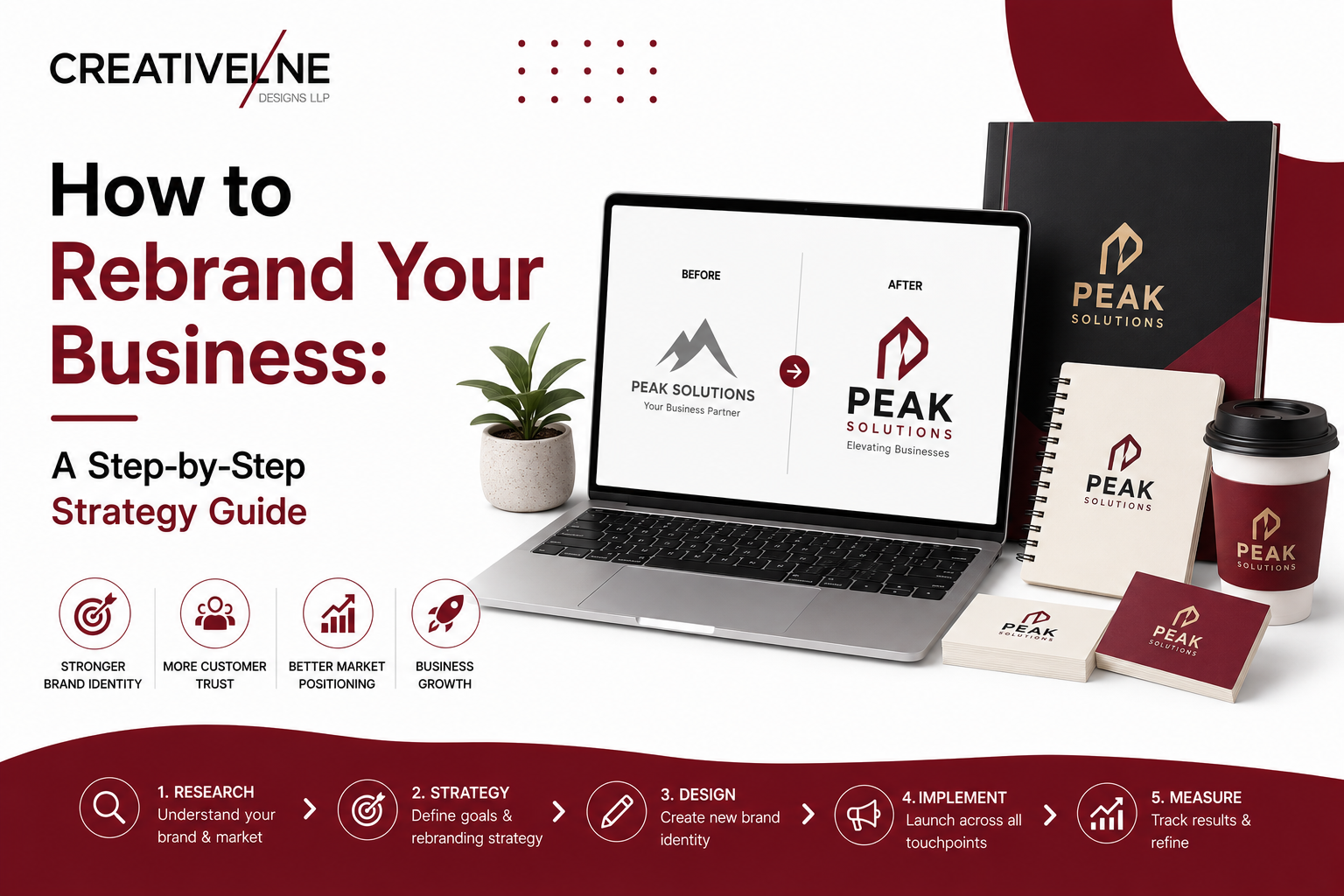
Rebranding a business is the strategic process of changing how a company looks, sounds, and is perceived — anything from a light visual refresh to a full overhaul of the name, identity, positioning, and customer experience. Done well, a rebrand unlocks new customers, justifies higher pricing, and clears the path for the next stage of growth. Done badly, it confuses loyal buyers, kills SEO traffic, and burns six to nine months of momentum. The difference is almost entirely about strategy and sequencing — not design taste. If you are weighing a rebrand, working with a partner that delivers strategy-led graphic design services is the single biggest factor in whether the rebrand pays back.
This guide covers when to rebrand, the step-by-step process, the costs, the timelines, the SEO and customer-retention risks, and the mistakes that turn a rebrand into a setback.
What Is Rebranding?
Rebranding is the deliberate change of one or more parts of a brand — the name, the logo, the visual identity, the positioning, the messaging, or the customer experience — to better fit where the business is going.
There are three common scopes:
- Brand refresh — a modernised logo, updated colour and type, slightly evolved messaging. The business stays recognisable.
- Partial rebrand — significant identity overhaul but the name and core positioning stay. The business looks substantially new.
- Full rebrand — new name, new identity, new positioning. The business essentially relaunches.
Most rebrands fall into the first two categories. Full rebrands are rare and high-risk.
When to Rebrand: The Real Triggers
Founders often rebrand for the wrong reason — they are bored of the current look. The right reasons are usually one of these.
1. The Business Has Outgrown Its Original Identity
A startup that began as a single product brand is now selling five categories. A local business is going national. A B2C brand is moving into B2B. The original identity was built for a smaller story.
2. The Audience or Positioning Has Changed
The business now sells to a different customer at a different price point. Premium customers will not buy from a brand that looks budget. Budget customers will not buy from a brand that looks unaffordable. The identity has to match the new positioning.
3. Competitors Have Caught Up Visually
Categories evolve. A logo and pack design that felt fresh five years ago can look dated next to current competitors. Visual obsolescence is real.
4. After a Merger, Acquisition, or Pivot
Material changes in the business almost always require a corresponding change in the brand.
5. The Brand Has a Reputation Problem
A controversy, a quality issue, or a leadership change sometimes calls for a brand reset.
6. Trademark or Legal Issues
A naming conflict or trademark dispute forces a name change. This is the most expensive trigger because it is involuntary.
If none of these apply, what you actually need is a content and marketing refresh — not a rebrand.
The Cost of Getting Rebranding Wrong
Three things commonly go wrong.
Customer confusion. Loyal customers who stopped recognising the brand stop buying from it. The lost revenue can take months to recover even when the rebrand is good.
SEO traffic loss. A new domain, new URLs, or sloppy redirects can wipe out years of search traffic in weeks.
Distribution disruption. For FMCG brands, new packaging means trade education, shelf re-stocking, and a window where stores carry both old and new packs. Every week of confusion is lost sell-through.
The single biggest predictor of which rebrands succeed is whether the strategy and sequencing was thought through before design work started.
The 8-Step Rebranding Process
A complete rebrand follows roughly this sequence.
Step 1: Audit the Current Brand
Map the current brand across every touchpoint — logo, packaging, website, social, ads, signage, collateral, internal documents. Identify what is working, what is broken, and what is invisible.
Step 2: Research the Audience and Category
Talk to current customers, lapsed customers, and target customers. Map the competitor landscape. Identify the visual and verbal conventions of the category and the white space the rebrand can occupy.
Step 3: Define New Positioning
The hardest and most important step. Decide who the brand is for, what it stands for, what it promises, and how it is different. Most failed rebrands skip this step and go straight to design.
Step 4: Develop the Visual and Verbal Identity
Logo, colour, typography, photography style, iconography, voice, and tone — all developed against the new positioning, with logo design importance sitting at the centre of every other identity decision.
Step 5: Build Brand Guidelines and Asset Kit
The full rulebook plus templates, files, and starter creative for every team that will touch the brand.
Step 6: Plan the Rollout
Map every touchpoint that needs to change — packaging, website, signage, social, ads, email, app, business stationery, signage, vehicle livery, uniform — and sequence the rollout. This is where most rebrands lose control of cost and timeline.
Step 7: Execute the Rollout
Apply the new brand across every touchpoint in the planned sequence. For physical products, manage the transition window where old and new packs coexist on shelf.
Step 8: Communicate the Rebrand
Tell customers what is changing and why. Internal communication first, then customer email, social, and PR. The story needs to be consistent across every audience.
Rebranding and SEO: How Not to Lose Your Search Traffic
This is where many rebrands quietly go wrong. A few non-negotiables.
Keep the Domain if You Can
A new domain forces you to start the SEO journey from near-zero. If the domain has any age and authority, find a way to keep it.
If the Domain Has to Change
Set up 301 redirects from every old URL to its new equivalent. Keep redirects live for at least 18 months — ideally permanently. Submit the old and new sitemaps to Google Search Console. Use the change-of-address tool.
Preserve URL Structure Where Possible
Even if the domain stays, changing every URL slug breaks internal links and external backlinks. Keep slugs unless you have to change them.
Update Schema and Open Graph Tags
The new brand name needs to be reflected in structured data and social tags or Google can keep showing the old name in search results for months.
Don’t Take the Site Offline During Rebrand
A staging site for the rebuild, a controlled cutover, then live. A site offline for days is an SEO setback that takes months to recover from.
Rebrands that ignore UI/UX SEO fundamentals often lose 50–80% of their organic traffic in the first quarter post-launch.
How Much Does Rebranding Cost in India?
| Scope | Cost Range | Includes |
| Brand refresh (logo + visual update) | ₹50,000 – ₹2,00,000 | Logo refresh + colour and type update |
| Partial rebrand (identity overhaul) | ₹2,00,000 – ₹8,00,000 | Strategy + identity + guidelines + key applications |
| Full rebrand (new name + identity) | ₹6,00,000 – ₹25,00,000+ | Naming + strategy + identity + full rollout |
| Enterprise rebrand | ₹20,00,000 – ₹2,00,00,000+ | Multi-region, multi-touchpoint, full programme |
These ranges cover the design and strategy fees only. Rollout costs — new packaging plates, signage, uniforms, website rebuild, photography, ad creative, and trade communication — are typically equal to or larger than the design fees.
Realistic Timeline for a Rebrand
| Project Type | Strategy + Design | Rollout | Total |
| Brand refresh | 4–8 weeks | 2–4 weeks | 6–12 weeks |
| Partial rebrand | 8–14 weeks | 6–12 weeks | 4–6 months |
| Full rebrand (new name) | 12–20 weeks | 12–24 weeks | 6–12 months |
| Enterprise rebrand | 20+ weeks | 6–18 months | 9–24 months |
Anyone promising a full rebrand in 30 days is selling you a logo change, not a rebrand.
Rebranding for Different Business Types
FMCG Brand Rebrand
The biggest rebranding category in India. The pack is the brand. Plan for trade education, distributor briefings, transition windows on shelf, and updated marketplace listings, with the new shelf appeal packaging earning back distribution wins lost during the transition.
D2C Brand Rebrand
Most D2C rebrands are about moving up-market or repositioning to a new audience. The website, marketplace listings, ad creative, and unboxing experience all change together. The window between announcing and rolling out is short — D2C customers expect everything to feel new on launch day.
Service Business Rebrand
Service businesses rebrand around growth — moving from local to national, adding service lines, raising prices. The website does most of the heavy lifting in a service rebrand.
B2B Rebrand
B2B rebrands are usually about earning credibility for a bigger sale. The website, sales collateral, case studies, and pitch decks are the priority touchpoints.
Common Rebranding Mistakes
- Skipping the strategy phase and starting with a logo redesign
- Designing for the founder’s taste instead of the customer’s preferences
- Changing the name when only the visual identity needed work
- Underestimating rollout cost — design is often 30% of the total bill
- Not migrating SEO properly — and losing 50–80% of organic traffic in the process
- Communicating the rebrand poorly — leaving loyal customers feeling abandoned
- Going dark on social during the transition — momentum loss is hard to recover
- Releasing new packaging without trade preparation — and finding old stock blocking shelves for months
A strategy-led branding agency treats every one of these mistakes as a process failure to design out, not a creative judgement call.
How to Communicate a Rebrand Without Losing Customers
A simple sequence that works:
- Internal first. Brief the team a week before any external announcement. They will be the ones answering customer questions.
- Loyal customers next. A direct email to your top customers explaining what is changing and why, before they see it anywhere else.
- Wider audience. Social, email newsletter, website banner, ad creative — all on the same day, all carrying the same story.
- PR. For larger rebrands, coordinated press coverage helps the new identity land faster.
- Trade and distribution. For physical products, a separate communication track to retailers and distributors.
The story matters. “Why we rebranded” is one of the most-read pieces of content a brand will ever publish if the reasoning is honest and the delivery is good.
Frequently Asked Questions
How much does it cost to rebrand a business in India? ₹50,000–₹2,00,000 for a brand refresh, ₹2,00,000–₹8,00,000 for a partial rebrand, and ₹6,00,000–₹25,00,000+ for a full rebrand including a new name. Rollout costs are usually equal to or larger than design fees.
How long does a rebrand take? A brand refresh takes six to twelve weeks. A partial rebrand takes four to six months. A full rebrand including a name change takes six to twelve months from kickoff to complete rollout.
Will a rebrand hurt my SEO? It can if it is not handled correctly. Keeping the domain, setting up proper 301 redirects, preserving URL structure, and updating schema are the controls that protect SEO during a rebrand.
Should I rebrand or just refresh? Most businesses need a refresh, not a rebrand. A full rebrand is justified when positioning, audience, or category has fundamentally changed.
How do I know if my brand needs to be rebranded? The clearest signals are outgrowing the original story, moving up or down market, the look feeling dated next to competitors, or a major business change like a merger or pivot.
What is the biggest mistake in rebranding? Skipping the strategy phase and going straight to design. A new logo on top of unclear positioning solves nothing.
Can I rebrand without changing my name? Yes, and most rebrands are exactly this. Keeping the name preserves equity and SEO while everything else gets rebuilt.
Plan a Rebrand That Moves the Business Forward
If you are considering a rebrand, the worst time to start is once you are already six months in. A clear strategy, a sequenced rollout, and the right team make the difference between a rebrand that pays back and one that costs the business a year.
