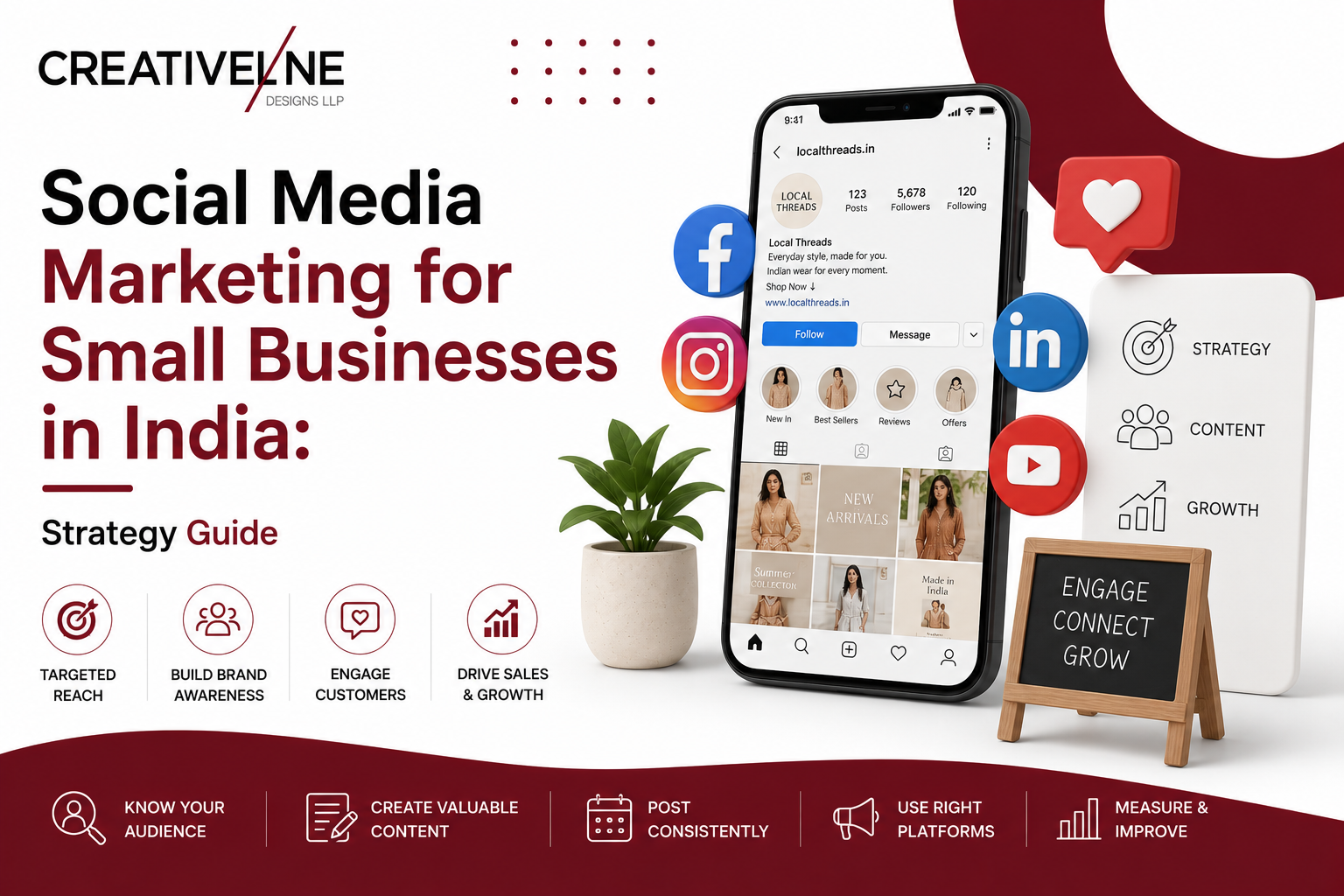
Social media marketing for small businesses in India is the work of growing visibility, trust, and leads through consistent content, smart paid promotion, and direct conversation with the audience on the platforms they actually use. For most small businesses that means Instagram, WhatsApp, Facebook, and increasingly LinkedIn and YouTube Shorts. The businesses that win are not the ones posting the most — they are the ones with a clear content system, brand-aligned creative, and a small but disciplined paid budget. If your social activity is feeling random or your reach has flatlined, working with a social media marketing services team that focuses on creative-led performance is usually the fastest unlock.
This guide breaks down the platforms, the content mix, the posting frequency, the cost ranges, and the specific levers that move the needle for small businesses in India.
Why Social Media Matters for Small Businesses
A small business has two realistic paths to growth — referrals and search, or social. Most need both. Social does three things that other channels do not.
- It builds trust before the sale. People check your Instagram before they enquire. A weak feed costs you leads silently.
- It compounds over time. A single great post can keep delivering reach and DMs for years. A search ranking takes longer to earn but social is faster to test.
- It works at small budgets. Search ads in competitive categories now cost ₹40–₹400 per click. Social can deliver leads at a fraction of that cost when the creative is strong.
A clear social media content strategy is what turns those advantages into actual lead flow instead of vanity metrics.
The Right Platforms for Indian Small Businesses
Pick the platforms where your audience already spends time. Spreading thin across all of them is a guaranteed way to underperform on each.
The default for almost every consumer-facing small business — D2C, beauty, fashion, food, fitness, services. Reels, Stories, and the main feed each play different roles. Best for visual products, lifestyle services, and brands building community.
Underused as a marketing channel by most small businesses. The WhatsApp Business app and Click-to-WhatsApp ads on Meta are now the highest-converting lead path for many service businesses in India. Catalogues, broadcast lists, and quick-reply templates do most of the work.
Still significant for older audiences, Tier 2 and Tier 3 cities, and certain B2B and local categories. Even when organic reach is low, Facebook ads remain a strong paid channel because of audience size and ad cost.
For B2B services, agencies, consultants, founders selling to founders, and recruiters. Organic reach on LinkedIn is still high in India because the platform is still underused relative to its user base.
YouTube and YouTube Shorts
Long-form for education and trust-building. Shorts for reach. Strong for service businesses and FMCG brands willing to invest in video.
Twitter / X
Niche but powerful for tech, startup, and creator businesses. Less useful for traditional small businesses.
Quora and Reddit
Often overlooked, but still effective for answering high-intent questions in specific categories.
For most small businesses, the right starting mix is Instagram + WhatsApp + one of LinkedIn or Facebook + a small YouTube presence.
Content Mix That Works for Small Businesses
Random posting is what kills most small business social media accounts. A simple weekly mix that works:
- 40% educational — answer questions your customers ask, explain how the product or service works, share useful tips from your industry
- 25% social proof — testimonials, reviews, customer photos, before-and-after results, case studies
- 15% behind-the-scenes — the team, the workshop, the kitchen, the founder, the process
- 10% product or offer-led — new launches, limited offers, seasonal pushes
- 10% trend or culture — relevant trending audio or formats, but only when they fit the brand
Creative formats to rotate:
- Static carousel posts for education and storytelling
- Short-form video (Reels, Shorts) for reach
- Stories for daily presence and polls
- Long-form video for deep trust building
- Live sessions for Q&A and launches
- User-generated content for social proof
Posting Frequency: What Actually Works
The right cadence depends on capacity, not platform myth. Here is what is realistic and effective for a small business.
| Platform | Posts per Week | Stories per Week | Notes |
| 3–5 (mix of feed + Reels) | 5–10 | Reels drive reach, feed builds memory | |
| 1–3 broadcasts | N/A | Don’t spam — segment by interest | |
| 3–5 | N/A | Long-form posts and carousels work best | |
| 2–4 | 3–5 | Mostly to support paid campaigns | |
| YouTube long-form | 1 | N/A | Quality > quantity |
| YouTube Shorts | 3–5 | N/A | Repurpose Reels |
A sustainable cadence beats a heroic one. The most expensive social mistake is starting at 14 posts a week, burning out at month two, and going silent for six months.
What Brand-Aligned Social Creative Looks Like
Three things separate scroll-stopping social creative from forgettable feed filler.
1. A Visual System the Audience Can Recognise in a Glance
Same colour palette, same fonts, same compositional rules across every post. Done well, the audience knows it is your brand before they read a single word. Done poorly, every post feels like a stranger.
2. Hooks That Earn the First Three Seconds
The first frame of a Reel, the first line of a caption, the cover slide of a carousel — these decide whether anyone watches the rest. Treat hooks as a separate craft and write five for every post before picking one.
3. A Clear Action at the End
Every post should leave the viewer with something to do — save, share, follow, comment, click the link, send a DM. Posts without an action build awareness but rarely convert.
Paid Social: How Much to Spend and Where
Organic alone is rarely enough for a growing small business. A modest paid budget pointed at proven creative consistently outperforms a large budget burned on guesswork.
Starter Paid Budgets (Monthly)
- Local service business: ₹15,000–₹40,000 per month, mostly on Meta ads to local audiences
- D2C brand (early stage): ₹40,000–₹2,00,000 per month, split between Meta and Google
- B2B service business: ₹25,000–₹1,00,000 per month, mostly on LinkedIn and Meta retargeting
- Established small business scaling: ₹2,00,000–₹10,00,000+ per month
Common cost benchmarks in India:
- Meta ad cost per click: ₹4–₹40 depending on category
- Click-to-WhatsApp lead cost: ₹15–₹150 depending on category
- Meta cost per 1000 impressions: ₹50–₹400
- LinkedIn cost per click: ₹70–₹300
These are wide ranges because category, geography, and creative quality all move them sharply. Strong creative can lower cost by 50%. Weak creative can double it.
How Much Does Social Media Marketing Cost in India?
| Service | Monthly Cost | Includes |
| Freelance basic management | ₹8,000 – ₹25,000 | 8–12 posts, basic captions, no strategy |
| Boutique agency starter | ₹25,000 – ₹60,000 | Strategy + 12–15 posts + Reels + analytics |
| Standard agency retainer | ₹50,000 – ₹1,50,000 | Full strategy + 20+ posts + paid management + reporting |
| Premium agency | ₹1,50,000 – ₹5,00,000+ | Full creative, video, paid, influencer, analytics |
Ad spend is on top of agency or freelancer fees. A common mistake is assuming the agency fee covers ad spend — it almost never does.
Common Small Business Social Media Mistakes
- Posting without a strategy — random topics, random formats, random schedule
- Treating every platform the same — recycling the exact same Instagram post on LinkedIn rarely works
- Skipping captions — a strong caption can double the engagement of the same image
- Ignoring DMs — the inbox is where leads close; ignoring it leaks revenue
- Buying cheap design — generic templated creative gets generic results
- No video — Reels and Shorts are now the largest single source of free reach; skipping them caps growth
- Switching strategies every month — meaningful results take 90+ days; jumping ship at week 6 prevents anything from working
- No tracking — without UTM tags, lead-source tracking, and basic analytics, every spend decision is a guess
How Social Connects to the Rest of Your Brand
Social media is the most visible expression of your brand. Everything has to align.
- Brand identity — colour, type, photography style — is the system the branding agency builds so every social post carries the same recognition cues.
- Packaging for product brands shows up in unboxing videos, founder content, and customer-generated reels, and the shelf appeal packaging decisions made for retail are exactly what makes a product worth filming.
- Product photography is the raw material for social ads — a planned ecommerce product photography shoot can fuel six months of paid creative.
- Website and UI is where the social click lands, and the UI/UX conversion rate on that landing experience decides whether the ad spend pays back.
A small business that invests in social without investing in the brand around it is filling a leaky bucket.
A Realistic 90-Day Social Plan for a Small Business
Days 1–14: Strategy and Setup
Audit current accounts, define the audience, lock the visual system, build a content calendar, set up tracking.
Days 15–60: Build Volume and Test
Post consistently against the calendar. Run small paid tests across 3–5 creative variations to find the winners. Reply to every comment and DM.
Days 60–90: Scale What Works
Double paid spend on the winning creative. Repurpose top organic posts into ads. Begin a UGC or influencer micro-campaign. Review numbers and adjust the calendar.
This is enough to know whether social is working for your business and where to invest next.
Frequently Asked Questions
How much does social media marketing cost for a small business in India? ₹8,000–₹25,000 per month for freelance management, ₹25,000–₹60,000 for a boutique agency starter retainer, and ₹50,000–₹1,50,000+ for a standard agency retainer. Ad spend is separate.
Which social media platform is best for a small business in India? Instagram for almost every consumer-facing small business, WhatsApp for direct lead conversion, and LinkedIn for B2B service businesses. Most should pick two to three platforms and go deep.
How often should a small business post on social media? Three to five posts per week on Instagram with five to ten Stories, three to five posts on LinkedIn for B2B, and one to three WhatsApp broadcasts per week. Sustainable cadence beats heroic bursts.
Do I need to run paid ads on social media? For most growing businesses, yes. Organic alone is rarely enough. A small disciplined paid budget on proven creative outperforms larger budgets on weak creative.
How long does social media marketing take to show results? Visible engagement lift in 30–45 days, meaningful lead flow in 60–90 days, compounding growth over six to twelve months. Switching strategies before 90 days is the most common reason results never appear.
Can I do social media marketing myself? Yes for the early stage of a very small business, especially the strategy and replies. The limits show up at scale — design quality, content production, and paid optimisation usually need outside help once the business is past its first year.
What is the most important social media metric for a small business? Leads or sales attributed to social, not followers or likes. A 1,000-follower account that drives 30 qualified leads a month is more valuable than a 50,000-follower account that drives none.
Build a Social Media Engine That Earns Real Leads
If your social media is stuck, off-brand, or not producing leads, we help small businesses across India build social systems that look right, sound right, and convert. Strategy, creative, and paid — built around what your business actually needs to grow.
