
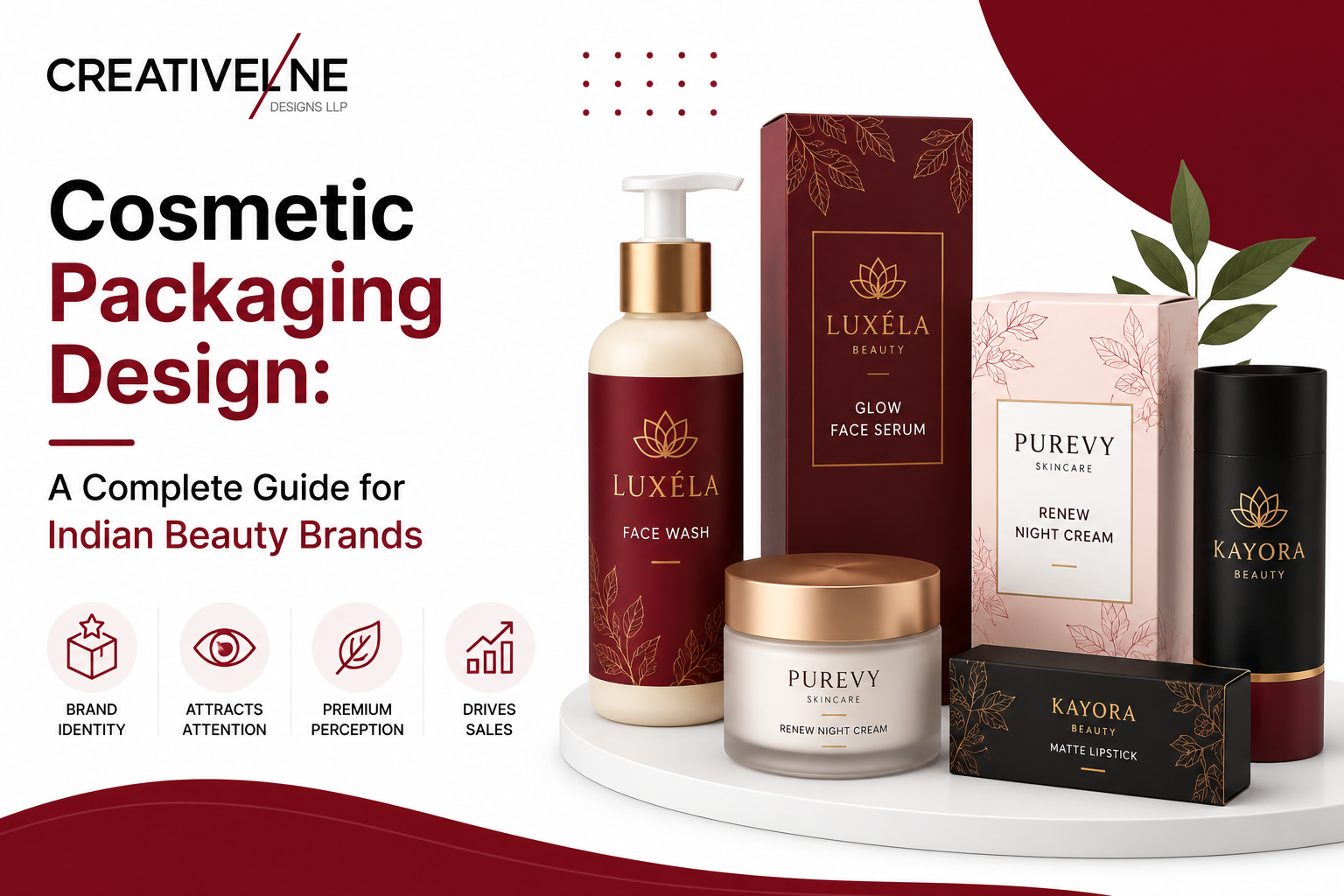
Cosmetic packaging design is the visual and structural design of containers, labels, and outer cartons for skincare, haircare, makeup, and personal care products. In a category as crowded as beauty, the pack does most of the selling — the customer decides in three to five seconds whether to pick it up, and that decision is based almost entirely on how the packaging looks, feels, and signals the price tier. A strong cosmetic pack works on the shelf, on a marketplace listing, in an unboxing video, and in a bathroom shelfie. If you are launching a beauty brand or relaunching an existing one, partnering with a packaging design company that has worked across cosmetic verticals is the fastest way to avoid the design and regulatory mistakes that kill beauty launches.
This guide covers the design decisions, materials, regulatory requirements, cost ranges, and trends that shape successful cosmetic packaging in India in 2026.
Why Cosmetic Packaging Design Decides the Sale
Beauty buyers are unusually visual. They scroll through dozens of products, compare looks at the shelf, and screenshot what they want to remember. The pack is the brand for them, especially before they have tried it.
Three things the packaging has to do at once:
- Signal the price tier. A ₹150 face wash and a ₹1,500 face wash often have similar formulations. The packaging is what tells the customer which one this is. Materials, finish, and structural quality do most of this work.
- Communicate the benefit fast. Beauty buyers scan for the promise — brightening, anti-ageing, hydration, acne-control. The pack has to land that benefit in under two seconds.
- Look right in the customer’s life. The product will sit on a bathroom counter and appear in selfies. The pack has to be something the customer is happy to display.
All three jobs are downstream of the packaging buying decisions buyers make in the first three seconds of seeing the pack.
The Cosmetic Packaging Categories You Need to Design For
Cosmetic packaging is not one design problem. It is at least five, and each one has different rules.
1. Skincare Packaging
Skincare leans on calm palettes, clean typography, and structural elegance. Glass droppers, frosted bottles, and matte tubes all carry strong quality cues. The dominant aesthetic is “clinical but warm” — enough whitespace and ingredient-led messaging to feel science-backed, with enough texture to feel approachable.
2. Haircare Packaging
Haircare packs need to handle wet hands, bathroom humidity, and frequent grip. Structural design matters more here than in any other beauty category — the bottle has to be ergonomically right. Visual design tends to be bolder than skincare because shampoo and conditioner ranges fight for shelf attention in a busy category.
3. Makeup Packaging
Makeup packs are part product, part accessory. Lipstick cases, compact mirrors, and palette designs are decorative objects — the customer sees them every day. The look needs to match the brand’s positioning at every touch.
4. Bath and Body
Larger pack sizes, bolder colour, and tactile textures define this category. Soaps, body washes, and bath salts are often gifted, so unboxing matters too.
5. Wellness and Ayurvedic Beauty
A fast-growing segment in India, ayurvedic and wellness beauty packs balance traditional cues — earthy palettes, hand-drawn botanical illustrations, ingredient-forward labels — with modern design discipline.
Cosmetic Packaging Materials: What to Pick and When
The material decision is half the design decision. Here are the choices and what they signal.
| Material | Best For | Cost | Premium Signal |
| Glass | Serums, perfumes, premium oils | High | Very high |
| Acrylic | Premium creams, foundations | Medium-high | High |
| PET plastic | Mass skincare, body wash | Low | Low to medium |
| HDPE plastic | Shampoos, lotions | Low | Low |
| Aluminium | Premium tubes, deodorants, candles | Medium | High |
| Paperboard outer cartons | Almost all categories | Low-medium | Adjustable based on finish |
| Bioplastics and PCR | Sustainable positioning | Medium-high | Strong with eco-conscious buyers |
A premium serum in a PET bottle will feel cheap no matter how good the label is. A mass shampoo in a glass bottle will be over-priced for the category. Get the material right first.
Cosmetic Packaging Design Trends in 2026
A few clear directions are dominating the category right now.
Refillable Architecture
More brands are launching refill systems — a beautiful, durable outer container with a refillable inner pouch or pod. This is both a sustainability story and a customer-retention mechanism.
Ingredient-Forward Labels
Buyers want to see actives. Niacinamide, vitamin C, hyaluronic acid, salicylic acid — when these are the hero ingredients, they belong on the front panel in legible type. The “minimalist hero label” approach has taken over the skincare category.
Soft-Touch and Matte Finishes
Soft-touch laminates and matte coatings give plastic the perceived value of glass at a fraction of the cost. This is now standard on premium-tier mass skincare.
Editorial Typography
Serifs are back. Brands are using high-contrast, magazine-style typography to push products from pharmacy shelves into beauty-editorial territory.
Sustainable Storytelling
Recyclable, refillable, and PCR-content claims are no longer differentiators — they are baseline expectations for new-launch brands targeting urban Indian buyers.
Maximalist Heritage Packaging
A counter-trend that is working well for ayurvedic and traditional beauty brands — illustrated botanicals, gold foil, jewel tones, and pattern-rich label design that signals craft and tradition.
Regulatory Requirements for Cosmetic Packaging in India
Cosmetic packaging in India has to comply with mandatory labelling rules under the Drugs and Cosmetics Rules and the Legal Metrology (Packaged Commodities) Rules. The pack must show:
- Brand name and product name
- Manufacturer name and address
- Net quantity in metric units
- Manufacturing date and best-before or expiry date
- Batch number and manufacturing licence number
- List of ingredients in descending order
- MRP inclusive of all taxes
- Country of origin
- Customer care details
- Specific warnings where required (for hair dyes, bleach, etc.)
Imported cosmetics carry additional labelling rules. Get a compliance check from a regulatory consultant before plates go to print — it is much cheaper to fix at design stage than after a recall.
How Much Does Cosmetic Packaging Design Cost in India?
| Scope | Cost Range | Includes |
| Single SKU pack | ₹15,000 – ₹50,000 | Label design + outer carton |
| Range of 3–5 SKUs | ₹50,000 – ₹2,00,000 | Range design system + variants |
| Full beauty range (10+ SKUs) | ₹2,00,000 – ₹10,00,000 | Architecture, range design, secondary, dielines |
| Premium / international-grade | ₹5,00,000+ | Strategy, structural design, full launch system |
Costs go up sharply when the project includes structural design, custom dielines, or photography to support the launch.
The Cosmetic Packaging Design Process
A complete pack project usually moves through these steps.
Step 1: Brief and Brand Audit
The agency studies the brand, the product range, the positioning, and the price tier the brand wants to play in.
Step 2: Category and Competitor Audit
Designers map what is on shelf. They identify the conventions that exist in the category, the white space the new range can occupy, and the cues that signal each price tier.
Step 3: Structural and Material Selection
Material, container shape, and closures are picked. Sometimes the agency works with a separate structural designer or pack supplier at this stage.
Step 4: Visual Concept Development
Two or three label and carton directions are developed. Each direction includes the front panel, side panels, and a sense of how the range will scale across SKUs.
Step 5: Refinement and Range Build
The chosen direction is built out across every SKU in the range, with consistent architecture and clear variant differentiation.
Step 6: Print-Ready Files and Mockups
Final dielines, print-ready artwork, and 3D mockups are delivered. Many projects end with a printed dummy pack for sign-off before plates are made.
Step 7: Launch Asset Kit
A good agency also delivers the launch asset kit — product photography, social-ready content, marketplace banners — built off the same visual system.
What Separates Beauty Packaging That Sells From Packaging That Doesn’t
After working on many beauty launches, the patterns are clear.
What works: – Clear hero benefit on the front panel – Material quality matched to price tier – Range architecture that lets variants be distinguished at a glance – Tactile finishes (soft-touch, foil, deboss) used sparingly and intentionally – Photography and packaging designed together, not separately
What fails: – Generic templates that look like every other clean-beauty brand – Too much text on the front panel – Inconsistent variant differentiation (customers mistake one SKU for another) – Material chosen on cost alone without thinking about category signal – Compliance information added late, breaking the layout
For categories with crowded retail aisles, the shelf appeal packaging playbook is what separates a launch that moves units from one that sits.
How Cosmetic Packaging Connects to the Rest of the Brand
Beauty is the most visual category in retail. The pack has to align with everything around it.
- Logo and brand identity has to feel native to beauty, not transplanted from another category
- Product photography for marketplace and social needs to extend the pack’s visual world, which is why strong ecommerce product photography is built off the pack’s colour, lighting, and styling rules
- Social media creative has to use the same colour, typography, and texture system as the pack
- Website and marketplace listings have to carry the same visual codes the customer is seeing in store
When all of these align, the brand starts to look bigger than it actually is — which is exactly what beauty buyers reward.
Frequently Asked Questions
How much does cosmetic packaging design cost in India? ₹15,000–₹50,000 for a single SKU, ₹50,000–₹2,00,000 for a small range, and ₹2,00,000–₹10,00,000 for full beauty ranges with strategy, structural design, and launch assets.
What is the most important element of cosmetic packaging? The front panel — specifically, how clearly it communicates the brand and the product benefit in the first three seconds the buyer sees it.
What materials work best for cosmetic packaging? Glass and aluminium for premium, acrylic for mid-premium, PET for mass, paperboard outer cartons for almost everything. Match the material to the price tier you want to play in.
Is sustainable cosmetic packaging worth the cost? For brands targeting urban Indian buyers in the ₹500+ price band, yes. Refillable systems and PCR content are now expected at this tier.
How long does cosmetic packaging design take? Four to eight weeks for a single SKU. Three to four months for a full range.
Do I need a separate structural designer for cosmetic packaging? For standard bottles, jars, and tubes, no — your packaging supplier offers stock options. For custom container shapes, yes.
What labelling rules apply to cosmetic packaging in India? Mandatory information includes manufacturer details, ingredients, net quantity, MRP, batch number, manufacturing date, expiry, and country of origin. Imported cosmetics have additional rules.
Launch a Cosmetic Range That Customers Pick Up
If you are launching a beauty brand or refreshing an existing one, we design cosmetic packaging that earns shelf space, justifies premium pricing, and looks at home on a marketplace listing and a customer’s bathroom shelf.
