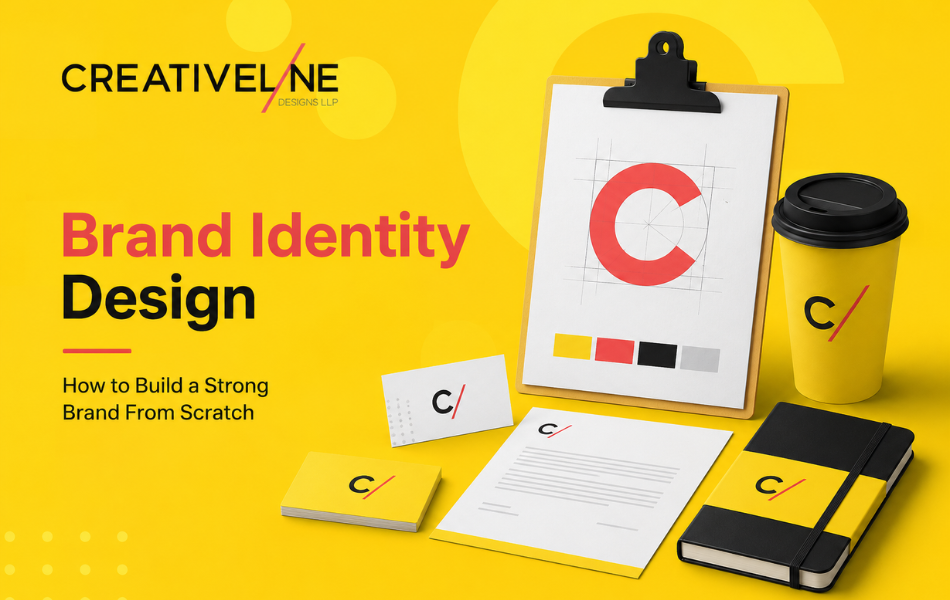
Brand identity design is the visible and verbal system that lets people recognise, remember, and trust your business. It is the logo, the colours, the typography, the packaging, the website, the tone of voice, and the way every piece of content fits together. A strong brand identity makes a small business look established, helps an FMCG product earn shelf space, and gives a startup the credibility it needs to charge a premium. If you are starting from scratch or rebuilding what you already have, working with a focused logo design agency is usually the fastest way to get the foundation right — the logo is the anchor, and every other element is built around it.
In this guide we cover what brand identity actually means, the elements that make it up, the step-by-step process designers follow, real examples, what it costs in India in 2026, and the mistakes that quietly drain business from companies that rushed this work.
What Is Brand Identity Design?
Brand identity design is the process of creating the visual and verbal assets that make a business recognisable. It includes everything a customer sees, reads, or interacts with — from the logo on your packaging to the colours on your Instagram feed to the way your invoices are formatted.
People often confuse three terms:
- Brand is the perception customers carry in their head about your business.
- Branding is the active work of shaping that perception.
- Brand identity is the toolkit of design assets used to do the shaping.
You cannot directly control the brand. You can absolutely control the brand identity. That is why this is where strategic work pays off.
Why Brand Identity Matters More Than Most Founders Realise
A consistent identity does three things for a business:
- It makes you memorable. Customers see hundreds of brands a week. The ones with sharp identities get filed away in memory; the rest blur into wallpaper.
- It justifies your pricing. Two products with similar quality can sell at very different price points if one looks expensive and the other looks generic. Identity is what closes that gap.
- It compounds every marketing rupee. A weak identity wastes ad spend because the audience cannot connect today’s ad with yesterday’s post or last month’s email. A strong identity makes every touchpoint reinforce the last.
If you want to dig deeper into how this works at the agency level, our explainer on what a branding agency does covers the strategic layer in more detail.
The 7 Core Elements of Brand Identity Design
A complete brand identity is built from seven repeating components. Skip any one of them and the system starts breaking under pressure.
1. Logo
The logo is the most distilled version of your brand. It needs to work at the size of a favicon and at the size of a billboard. It needs to read in colour and in single tone. It should not depend on a tagline or supporting text to communicate. The logo is the single asset that will appear on more surfaces than anything else, so the work spent here pays itself back many times over. If you are wondering whether this is worth the investment, our piece on why logo design is important for business branding lays out the case.
2. Colour Palette
A brand colour palette typically includes one primary colour, one or two secondary colours, and a small set of neutrals. Colours are not picked because the founder likes them — they are picked because of what they signal in the category. Wellness brands lean on muted greens and creams. Premium spirits lean on deep blacks, golds, and burgundies. Kids’ products use saturated primaries. The colour decision is downstream of the positioning, not upstream of it.
3. Typography
A brand usually uses two typefaces — one for headlines and one for body. Sometimes a third for accents. Type carries personality the way clothing does. A serif feels traditional and trustworthy. A geometric sans feels modern and confident. A handwritten script feels personal and crafted. The typefaces should be licensed for commercial use and available across web, print, and packaging.
4. Imagery and Photography Style
Brand photography rules cover what your photos look like, not just what they show. This includes lighting style, colour grading, framing, the kind of models or hands used, the surfaces and props. Two brands selling identical products can feel completely different based on photography alone — the sharp, clinical look of a serum brand versus the warm, lived-in look of a homemade jam brand are both choices.
5. Iconography and Graphic Elements
Icons, patterns, illustrations, and supporting graphic elements form the connective tissue of the identity. They show up in social media creatives, on packaging, in app interfaces. A consistent icon set keeps the brand visually coherent across every touchpoint.
6. Voice and Tone
Brand voice is the verbal identity — the way you write captions, product descriptions, customer support replies, and email subject lines. A premium brand might write in short, confident sentences. A friendly D2C brand might use contractions and the second person. The voice rules need to be documented and shared with everyone who writes anything for the brand.
7. Brand Guidelines Document
The deliverable that ties all of this together is the brand guidelines document — sometimes called a brand book or brand manual. This is the rulebook that anyone designing for the brand can refer to. It covers logo usage, clear space, colour codes, typography rules, image style, do’s and don’ts, and templates for common applications.
The Brand Identity Design Process Step by Step
Most strong identities are built through a sequence that looks roughly like this:
Step 1: Discovery and Brief
The agency interviews the founders, key team members, and sometimes existing customers. The goal is to understand the business model, the audience, the competitors, the positioning, and the founder’s vision. A short discovery questionnaire is usually filled out at this stage.
Step 2: Market and Competitor Research
Before any visual work starts, the design team studies the category. They map what competitors look like, what conventions exist, what colour and type patterns repeat. The point is not to copy — it is to identify the white space the new identity can occupy.
Step 3: Strategy and Positioning
This is the moment the design team decides what the brand should feel like. Words like “warm but clinical” or “premium but accessible” come out of this phase. These words then become the brief for the visual work.
Step 4: Concept Development
The team develops two or three distinct identity concepts. Each concept includes a logo direction, a colour palette, type choices, and sample applications. The founder picks one direction to develop further.
Step 5: Refinement
The chosen concept is refined across multiple iterations. The logo is tightened. The palette is finalised. The type is locked. Sample applications — packaging, social posts, business cards, website headers — are mocked up so the founder can see how the identity behaves in real contexts.
Step 6: Brand Guidelines and Asset Delivery
The final assets are delivered in print and digital formats — vector logos, web fonts, colour codes for screen and print, and the full brand guidelines document.
Step 7: Rollout
The identity is rolled out across all touchpoints — packaging, website, social media, signage, business stationery. This is where the strategic work meets reality.
Brand Identity Design Examples That Get It Right
A few patterns repeat across the best Indian brands:
- Paperboat — soft, hand-illustrated style across packaging and social, with a playful nostalgic voice.
- Mamaearth — clean greens and creams with a transparent, ingredient-led typography system.
- Bombay Shaving Company — muted earth tones, classic serif type, premium-but-approachable photography.
What unites them is not the look. It is that the look is the direct visual translation of the positioning. The packaging, the website, the Instagram feed, and the unboxing experience all feel like they came from the same place — because they did.
How Much Does Brand Identity Design Cost in India?
Pricing depends heavily on scope, agency tier, and the number of applications you need designed at launch. As a rough 2026 guide:
- Starter identity (logo + basic colour + type system + a one-page brand sheet): ₹25,000 to ₹60,000
- Standard identity (logo + full guidelines + 3–4 applications like packaging, social templates, business stationery): ₹75,000 to ₹2,50,000
- Comprehensive identity (full strategy + identity + packaging system + website + launch creative kit): ₹3,00,000 to ₹10,00,000+
Founders sometimes balk at the upper end. The honest answer is that the cost of redoing a weak identity 18 months in — including new packaging plates, new collateral, customer confusion, and lost SEO — is almost always higher than doing it right the first time.
The Most Common Brand Identity Mistakes
After years of working with FMCG and D2C founders, the same handful of mistakes keep appearing:
- Designing the logo in isolation without thinking about packaging, web, or social applications
- Picking colours based on personal taste instead of category positioning
- Using too many fonts — three is the maximum, two is usually better
- No written guidelines — meaning every new designer reinterprets the brand
- Skipping the strategy phase and jumping straight into visuals — this is the single biggest predictor of a brand needing a redesign within two years
If you are seeing any of these in your current setup, that is a strong signal that the brand needs a rebuild before you scale ad spend.
How Brand Identity Connects to Packaging, Web, and Marketing
Brand identity is not a one-time deliverable that you file away. It is the source of truth that every downstream design decision references.
- Packaging is where identity meets retail reality. A great identity that breaks down on shelf is a failed identity. Our piece on how packaging influences buying decisions is worth reading if you sell physical products.
- Website and UI is where identity meets functionality. A brand that looks beautiful but converts at 0.5% has not solved for the brief. The connection between UI/UX design and conversion is closer than most founders realise.
- Social media is where identity meets daily content production. Without templates and a clear visual system, social design becomes a daily reinvention exercise. Our take on content strategy for social media covers how to build a system that scales.
Frequently Asked Questions
What is the difference between a logo and brand identity? A logo is one element. Brand identity is the full system — logo, colours, typography, photography style, iconography, voice, and the rules that hold them together.
How long does brand identity design take? A standard identity project takes four to eight weeks. A comprehensive project including packaging and web can take three to four months.
Can I design my own brand identity? You can build a starter identity yourself, especially with template tools, but the moment your business needs to scale, hold up next to category leaders, or earn premium pricing, the limits of DIY become obvious very quickly.
What should brand guidelines include? Logo usage rules, clear space, minimum sizes, colour codes for print and screen, typography hierarchy, image style, do’s and don’ts, and templates for common applications.
How often should I update my brand identity? Most brands refresh every 5–7 years. A full rebrand happens when the business model, audience, or positioning has fundamentally changed.
Is brand identity the same as branding? No. Branding is the strategic work of shaping perception. Brand identity is the toolkit of design assets used to execute that strategy.
Build a Brand Identity That Earns Shelf Space, Trust, and Premium Pricing
A strong brand identity is the difference between being one of many and being the obvious choice. If you are building a new brand or rebuilding one that has outgrown its original look, we help FMCG, D2C, and startup teams across India design identities that work in the boardroom, on the shelf, and in the feed.
